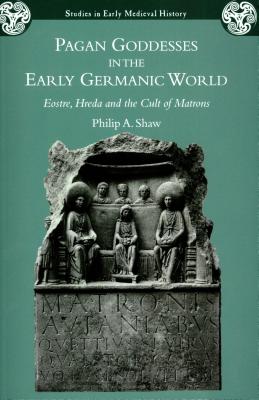
A quick note on the nature of this review. I am not an academic and I am not looking at this book from that perspective. I am examining this book from the angle of a reconstructing Fyrnsidere with no training as a historian or linguist. As such, I am not an expert and everything contained in this review are my opinions as a layperson.
I picked up Pagan Goddesses in the Early Germanic World: Eostre, Hreda and the Cult of Matrons by Philip A. Shaw in preparation for an upcoming post on Eostre and Hrēðe. It was referenced by several sources I found during my initial research, and I decided that it would be worth picking up myself.
Was it worth it? … Kinda?
I’ll be honest, when I first pulled the box containing this book out of my mailbox we were already off to a bad start on first impressions. When I pay damn near $50 USD for a book, even a scholarly one, I expect it to be a little heftier than this. If you decide to read this book for yourself, I highly encourage you to look for it at the library, borrow it from a friend, or thrift it. Save your money.
Initial annoyance aside, the book is quite densely packed. The back blurb describes it as a “readable introduction to some ways in which linguistic evidence can be brought to bear on historical issues.” I suppose readable is a subjective adjective. If you are accustomed to reading dense, scholarly material it may be a fair assessment. If you are not, then your mileage may vary.

If you’re looking for a deep dive on the linguistic arguments around Eostre and Hrēðe, this is your book. I will say that proponents of the Hrēðe-is-a-goddess-of-victory camp may not be pleased with his conclusions. His conclusions about Eostre are also… interesting. Personally, I agree and disagree with some of Shaw’s conclusions, but we’ll discuss my UPG in another post.
I do think Shaw’s point that scholars have focused too much on the roles of goddess too much vs their localities is an interesting one. He says in his conclusion on page 99 that “the goddesses of this book seem to point in the other direction, towards the tribal, the local, perhaps even the familial or personal.” Now, I highly doubt Shaw was intending to call out modern pagans with his statements. I am very much convinced that he was speaking to his fellow academics. But I do think this line perhaps gives food for thought about how we as modern Fyrnsideras approach our reconstruction and our gods. My thoughts on this are half formed at best, however, and I shall save them for a later discussion.
Aside from food for thought, my biggest takeaway from this book is perhaps its extensive bibliography. I suspect there’s more than one interesting gem in there.
In conclusion, do I think this book was worth the money I spent on it? No. Do I think it’s worth reading for my reconstruction journey? Yes.
Purchase Links
As I said above, I probably wouldn’t buy it new again, but here are some links if you would like to.
 Forþ-weard