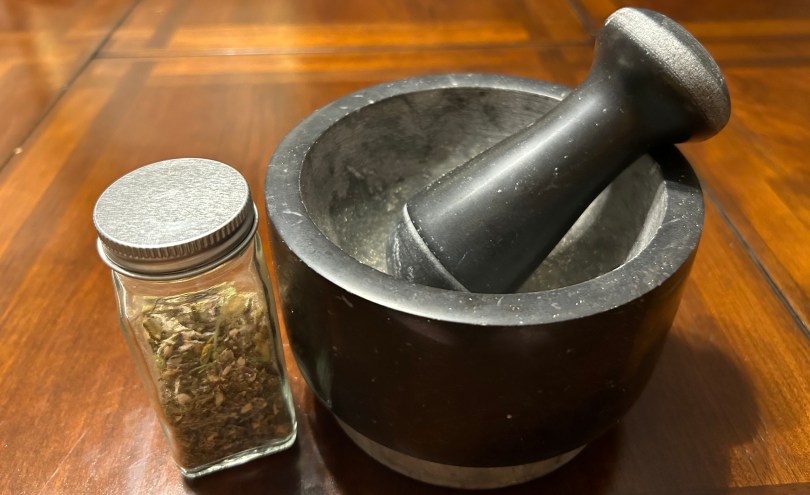
A spice jar of incense and a black stone mortar and pestle.

Nine Herb Charm Incense

Disclaimer: I AM NOT AN EXPERT. Do not touch, consume, burn, or otherwise mess with any plant you are unfamiliar with. Consult an actual herbalist or your doctor. For all the gods’ sakes, please exercise caution and common sense when working with herbs. Always burn incense in a well-ventilated space away from pets.


One of the rather frustrating things about reconstructing Anglo-Saxon paganism is the lack of written sources. What sources we do have were written in the centuries after conversion and tend to provide only tantalizing hints about what might have been. One such piece of writing is the “Nine Herb Charm,” a medical text that describes the use of a combination of, you guessed it, nine plants in a salve along with a lengthy verbal component.1

Were these nine plants the most sacred plants in Anglo-Saxon paganism? We don’t know. Heck, we’re not even 100% sure what some of them actually are. But, the Nine Herb Charm provides all sorts of interesting glimpses into the Anglo-Saxon pagan mind. For example, it mentions “the seven worlds,” informing us just a little about the Anglo-Saxon sense of cosmology.

Since the Nine Herbs are described—at length—to drive out poison and illness, I thought it would make perfect sense to adapt them into an incense recipe for cleansing during formal rituals.

Nine Herb Charm Incense

  • 1 part dried Mugwort
  • 1 part dried Plantain leaves
  • 1 part dried Bittercress
  • 1 part dried Betony
  • 1 part dried Chamomile flowers
  • 1 part dried Stinging Nettle
  • 1 part Applewood shavings
  • 1 part dried Parsley
  • 1 part Fennel seeds

I ordered everything except the parsley and applewood from an herb shop on Etsy. The parsley came from my pantry, and I shaved bits off a piece of the applewood my husband keeps around for his smoker. From there, I measured everything with a teaspoon into my mortar and gave it all a good smash to break up the big bits. This yielded me about half a spice jar of incense.

Guesses & Substitutions

Scholars aren’t entirely sure about the identity of some of the plants. Attorlaðe, for example, is unknown but thought by many to be woody betony.2 I did see someone claim that this plant was black nightshade, which I would not recommend. Cockspur grass is another common interpretation. I chose betony.

The next questionable interpretation is for “lamb’s cress.” Some people take it to mean watercress, while others say hairy bittercress or Cardamine hirsuta.3 I opted to use Cardamine bulbosa, a close relative to hair bittercress that is native to North America.4

My next swap is the applewood shavings. In the charm, they seem to be using a mash made of crabapples. I suppose I could have gotten my hands on some crabapples and dried their skin or something, but I think using a bit of applewood actually makes more sense for incense, especially given that the wood was intended for a smoker anyway.

And finally, there is the parsley. Some scholars believe that fille in the charm refers to chervil or a similar plant.5 Chervil is related to parsley,6 which is much more readily available in my local grocery store. Patti Wiggington uses thyme in her Nine Herb Charm salve.7

Don’t forget a good chant

I also wrote a little galdor to go with it because why not? The original charm had a verbal component, after all.

Nine herbs sacred burn and smoke
Remember all which past you smote
Drive out illness, malice, and pain
Clear this space of the profane.

Conclusion

Is this an exact replica of what was used in Anglo-Saxon times? Definitely not. But do I think it will make the right connections and enhance my praxis? Absolutely.

Let me know in the comments if you have a different Nine Herbs blend that you favor. I’d love to know!

  1. Read a translation here https://www.mimisbrunnr.info/nigon-wyrta-galdor ↩︎
  2. I went with betony, which is listed here: https://heorot.dk/woden-9herbs.html. However, you can find a couple of alternative suggested plants here https://www.herbalhistory.org/home/the-nine-herbs-charm-plants-poisons-and-poetry/ ↩︎
  3. https://www.mimisbrunnr.info/nigon-wyrta-galdor#wyrts ↩︎
  4. https://en.wikipedia.org/wiki/Cardamine_bulbosa ↩︎
  5. https://www.mimisbrunnr.info/nigon-wyrta-galdor#wyrts ↩︎
  6. https://en.wikipedia.org/wiki/Chervil ↩︎
  7. https://www.pattiwigington.com/saturday-spellwork-the-9-herbs-charm/ ↩︎

Sorry if I got a little lazy on the footnotes this time, y’all.
Book Review: The Darkening Age

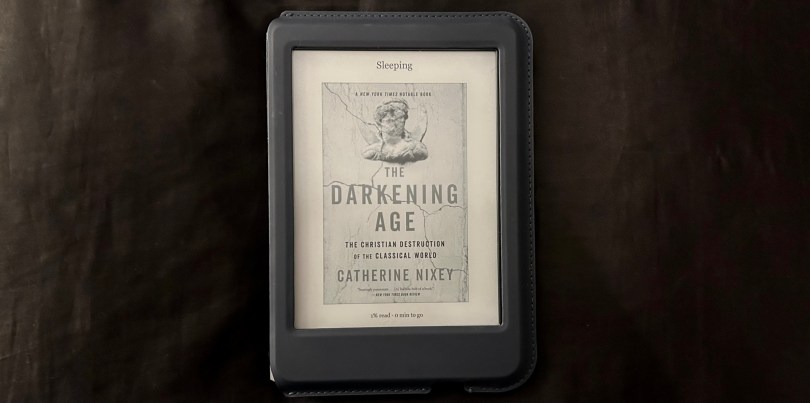
The Darkening Age: The Christian Destruction of the Classical World by Catherine Nixey takes the story of Christianity’s “triumph” and turns it on its head. The reader is taken on a journey through time where, piece by piece, the pagan Roman world is transformed.

I had always assumed that the rough condition of many ancient statues was primarily a function of age and rough handling by people who did not understand their value. Likewise, I attributed all of the lost literature to time, war, natural disasters, and general human carelessness. I’m sure those factors played a part, but I did not realize how much purposeful destruction was wreaked upon Greek and Roman art during Christianity’s rise to power. I suppose it really should not have surprised me.

After my initial shock, the primary emotions I felt throughout this book were an ebb and flow of grief and rage. For each thing preserved from ancient Rome, a hundred more were destroyed. How many great works of art, literature, and science did we lose? How many decades or even centuries of advancement did they hobble? It saddens me to think of all the books we’ll never read because some preacher or bishop decided to burn them.

Some may find Nixey’s condemnation of the early church heavy-handed, perhaps even a little rage-baity. Indeed, I found myself having to step away from the book at times. But I think it is important to see these events through the eyes of the pagan beholder—and not the victors who wrote the history books. And yet, because so much pagan writing was lost, Nixey must condemn the church fathers largely through their own words.

Speaking of sources; the citations, footnotes, and bibliography for The Darkening Age are extensive. I thought I still had almost half the book left when it ended, only to discover it was all back matter!

The writing itself is very approachable rather than academic or stuffy. The way Nixey weaves the overall narrative of the early church with stories and anecdotes from individual writers is very engaging.

All in all, I would recommend the book to anyone with an interest in the subject matter.

Building an Altar Shelf

I’ve recently had a drive to spruce up my general altar space (this is separate from my area dedicated to Frig). One of the things I really wanted was a shelf to elevate certain items. I looked all over the internet, and nothing felt quite right. So, I decided to do a little DIY. Fortunately, I have a very handy husband who no longer asks questions and just breaks out the measuring tape.

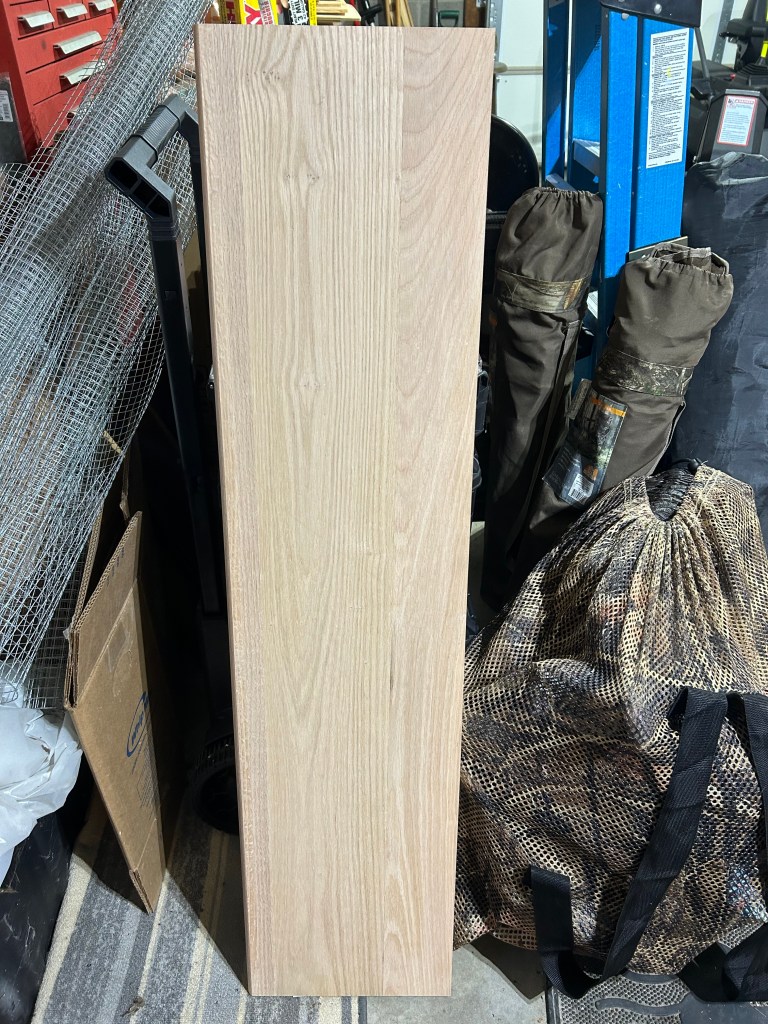
A picture of a 4ft stair tread propped against a toolbox and surrounded by misc stuff, including camping chairs, turkey decoys in a bag, and hardware cloth.

My first order of business was the wood. I did not want to make it out of pine or poplar, though I supposed I could have picked up an appropriately sized board at Home Depot. I was just starting to think I would have to go to a dedicated lumber store when I found this: a red oak stair tread.

Please ignore the camping chairs, bag of turkey decoys, hardware fabric, and other misc items in the picture. The garage really isn’t suited for photo shoots.

Is this the ideal material for building a shelf? Probably not. Was it easily accessible and easy to put in the backseat of my car? Absolutely.

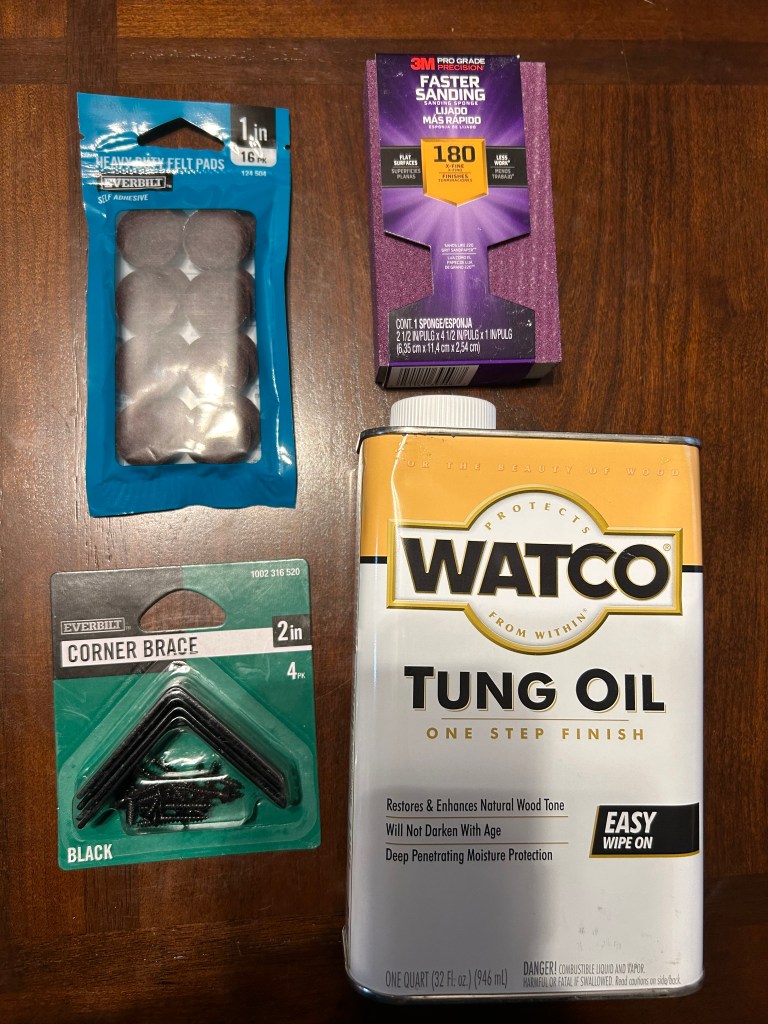
Here’s the full material list:

  • 4′ red oak stair tread
  • 4-pack of 2″ corner braces
  • 1 pack of 1″ felt pads
  • Fine sandpaper or sanding block
  • Tung oil (or whatever finish you prefer)

And the tools we used:

  • Table saw
  • Chop saw
  • Drill
  • Electric sander
A picture of the listed materials.

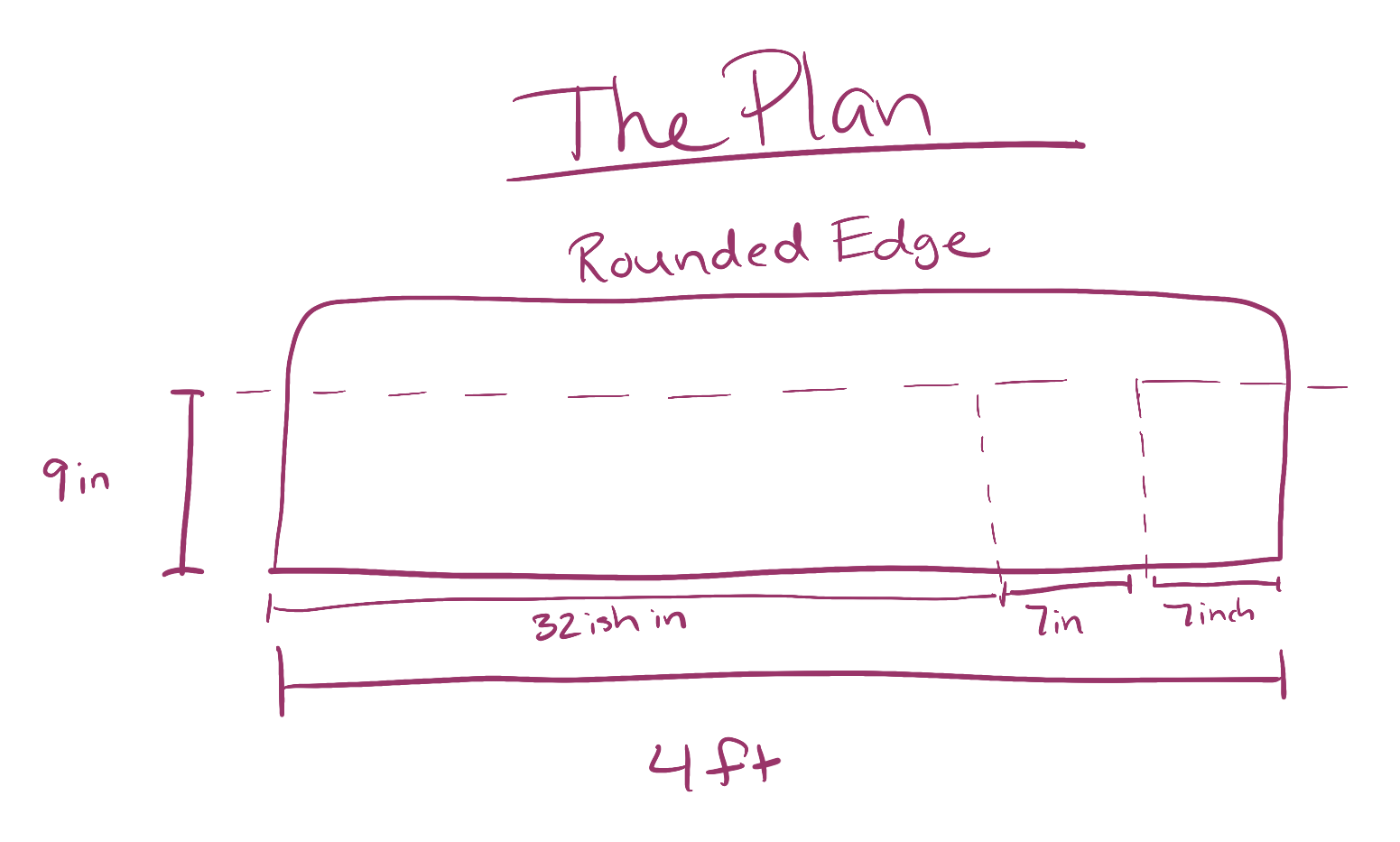
The space I wanted to put this in wasn’t really deep enough to accommodate the whole depth of the stair tread, so the first thing we did was rip it down to 9″ wide with the table saw. If you have the space for it, the rounded edge of the stair tread could actually make a nice front for the shelf. Alas, I do not have the space.

A sketch of how we cut the stair tread.
Here is a rough sketch from my iPad of how we cut the stair tread into the shelf pieces.

After that, my husband cut the legs from the main piece, measured at 7″ each. The remaining 32ish inches became the top piece. While he was doing that, I spot-tested how the tung oil would look on the scrap from step 1.

The chop saw burned the wood a bit, but I was able to get the marks off with the electric sander. I also used this to speed up the process of cleaning up the sharp edges of the cuts before finishing with very fine grit sandpaper.

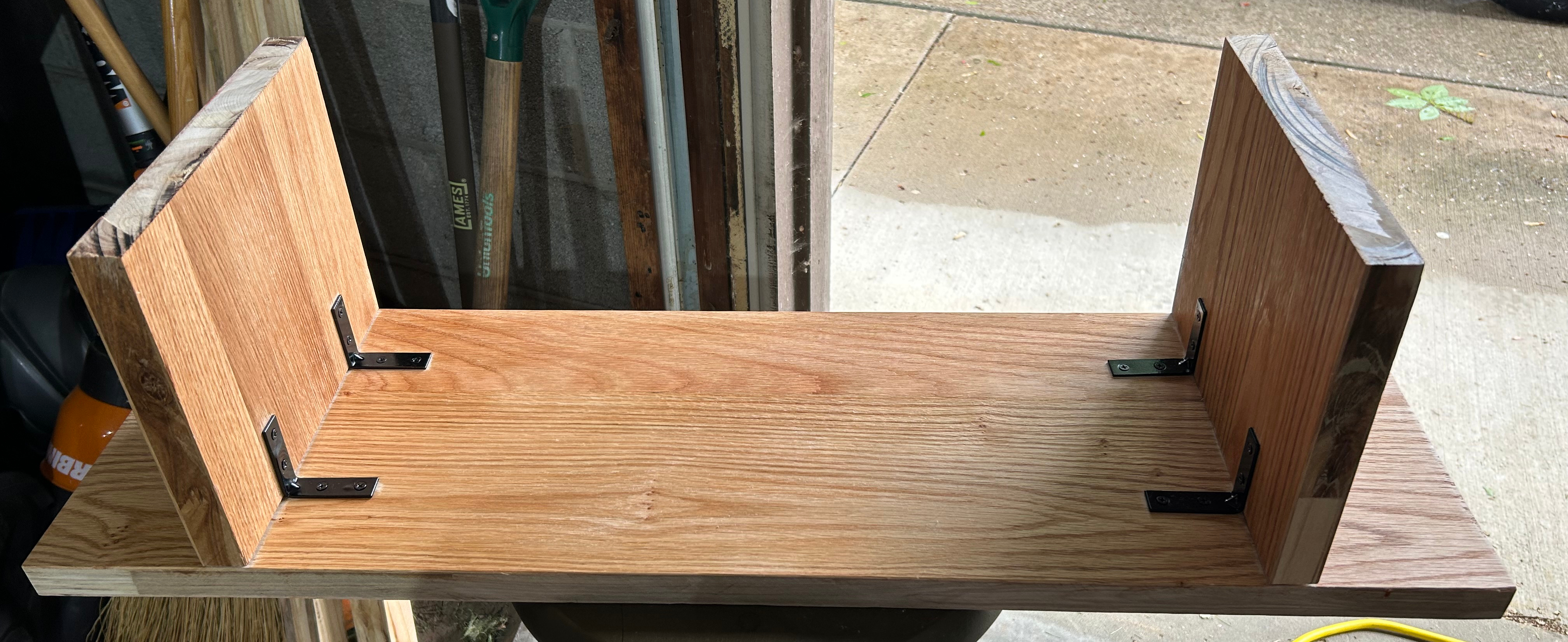
Then, it was time for assembly. I forgot to take pictures, but we measured 4″ in from each end and marked it. We then measured 2″ in along those lines on each side to mark where the braces would go. We placed a leg and a brace and marked the holes. Repeat for each brace.

Drill, baby, drill. Pre-drilling is important, especially since this is a hardwood. Hubby drilled all the holes, and then assembly began.

The shelf flipped upside down to show the corner braces
Here you can see the placement of the braces.

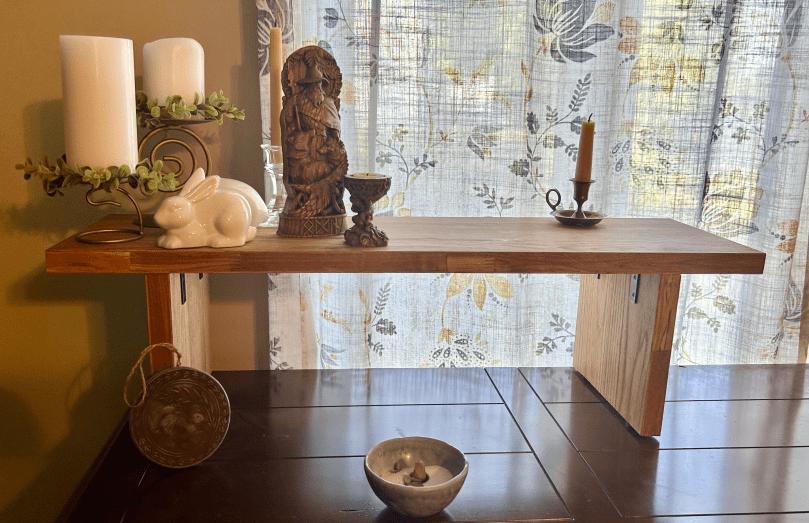
From there it was just a matter of rubbing on the tung oil and leaving it sit for 15 minutes before buffing it out. I let it cure for a day and then repeated the process and cured it one m ore day before adding the felt pads. And voila! A finished shelf for my altar space.

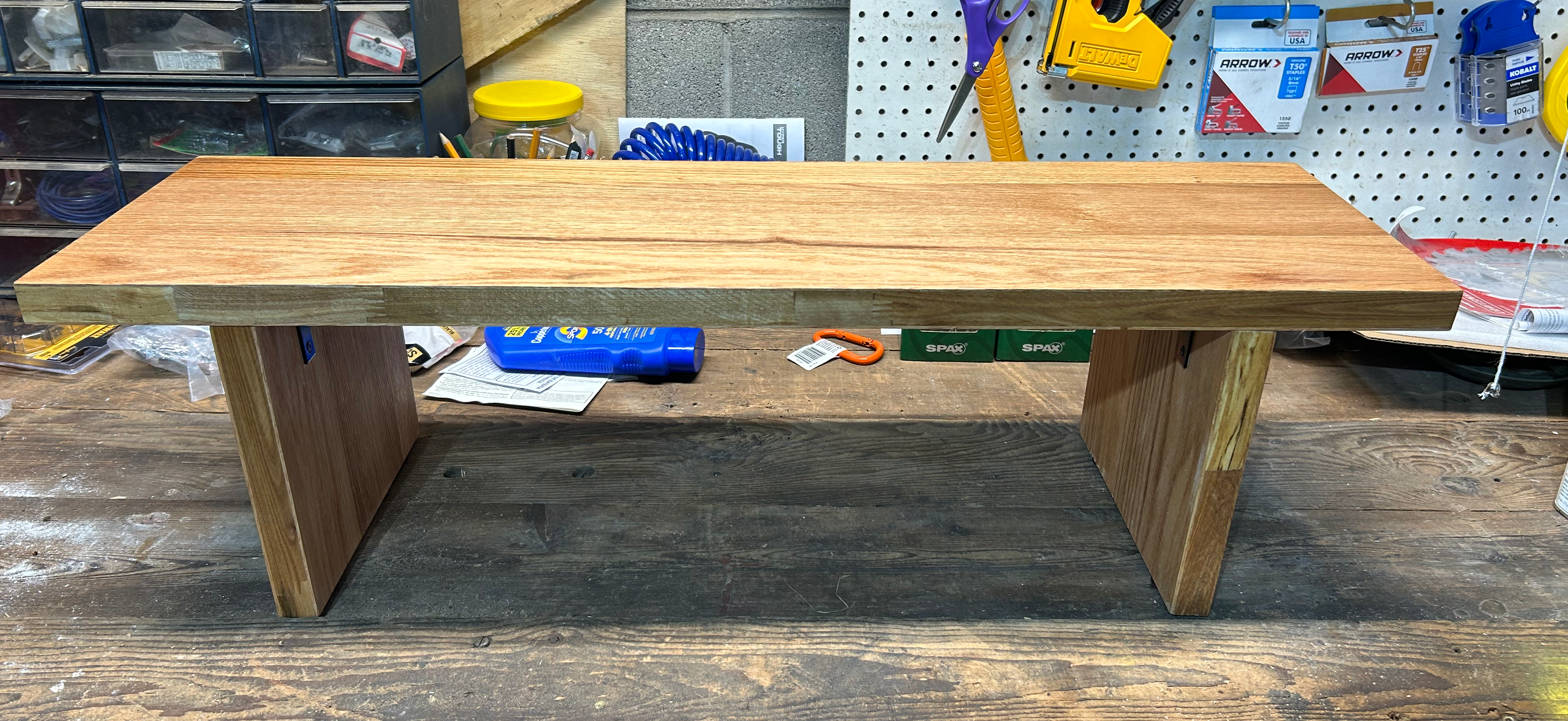
Finished shelf sitting on a work bench.
The finished shelf sits on the garage workbench

This was a really fun and gratifying project. The finished product is hardly perfect, but it was made with love and perfect for my needs. I’m looking forward to having this shelf in my sacred space for many years to come.