Book Review: The Darkening Age

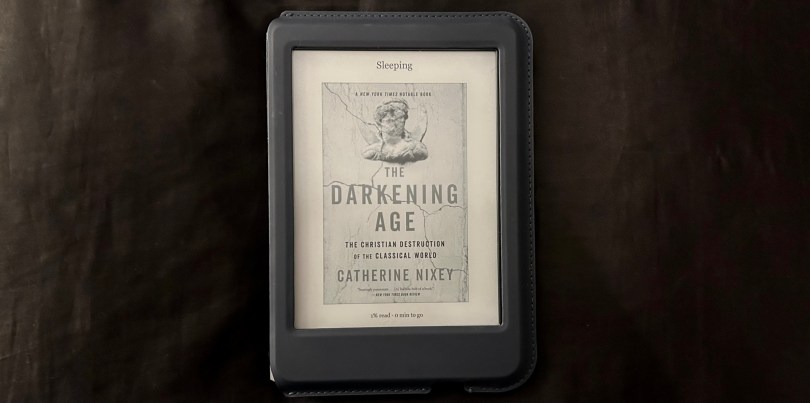
The Darkening Age: The Christian Destruction of the Classical World by Catherine Nixey takes the story of Christianity’s “triumph” and turns it on its head. The reader is taken on a journey through time where, piece by piece, the pagan Roman world is transformed.

I had always assumed that the rough condition of many ancient statues was primarily a function of age and rough handling by people who did not understand their value. Likewise, I attributed all of the lost literature to time, war, natural disasters, and general human carelessness. I’m sure those factors played a part, but I did not realize how much purposeful destruction was wreaked upon Greek and Roman art during Christianity’s rise to power. I suppose it really should not have surprised me.

After my initial shock, the primary emotions I felt throughout this book were an ebb and flow of grief and rage. For each thing preserved from ancient Rome, a hundred more were destroyed. How many great works of art, literature, and science did we lose? How many decades or even centuries of advancement did they hobble? It saddens me to think of all the books we’ll never read because some preacher or bishop decided to burn them.

Some may find Nixey’s condemnation of the early church heavy-handed, perhaps even a little rage-baity. Indeed, I found myself having to step away from the book at times. But I think it is important to see these events through the eyes of the pagan beholder—and not the victors who wrote the history books. And yet, because so much pagan writing was lost, Nixey must condemn the church fathers largely through their own words.

Speaking of sources; the citations, footnotes, and bibliography for The Darkening Age are extensive. I thought I still had almost half the book left when it ended, only to discover it was all back matter!

The writing itself is very approachable rather than academic or stuffy. The way Nixey weaves the overall narrative of the early church with stories and anecdotes from individual writers is very engaging.

All in all, I would recommend the book to anyone with an interest in the subject matter.
Book Review: Pagan Goddesses in the Early Germanic World

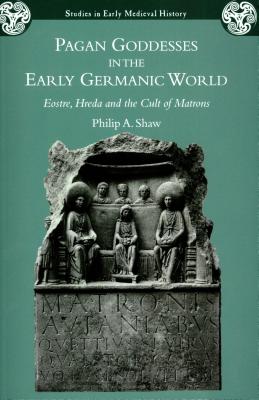
The cover of Pagan Goddess in the Early Germanic World by Philip A. Shaw.

A quick note on the nature of this review. I am not an academic and I am not looking at this book from that perspective. I am examining this book from the angle of a reconstructing Fyrnsidere with no training as a historian or linguist. As such, I am not an expert and everything contained in this review are my opinions as a layperson.


I picked up Pagan Goddesses in the Early Germanic World: Eostre, Hreda and the Cult of Matrons by Philip A. Shaw in preparation for an upcoming post on Eostre and Hrēðe. It was referenced by several sources I found during my initial research, and I decided that it would be worth picking up myself.

Was it worth it? … Kinda?

I’ll be honest, when I first pulled the box containing this book out of my mailbox we were already off to a bad start on first impressions. When I pay damn near $50 USD for a book, even a scholarly one, I expect it to be a little heftier than this. If you decide to read this book for yourself, I highly encourage you to look for it at the library, borrow it from a friend, or thrift it. Save your money.

Initial annoyance aside, the book is quite densely packed. The back blurb describes it as a “readable introduction to some ways in which linguistic evidence can be brought to bear on historical issues.” I suppose readable is a subjective adjective. If you are accustomed to reading dense, scholarly material it may be a fair assessment. If you are not, then your mileage may vary.

A picture of the side of the book showing how skinny it is.
The strange angle at which I took this picture makes the book appear taller than it is. But as you can see, it is quite skinny, and the internal text is not tiny.

If you’re looking for a deep dive on the linguistic arguments around Eostre and Hrēðe, this is your book. I will say that proponents of the Hrēðe-is-a-goddess-of-victory camp may not be pleased with his conclusions. His conclusions about Eostre are also… interesting. Personally, I agree and disagree with some of Shaw’s conclusions, but we’ll discuss my UPG in another post.

I do think Shaw’s point that scholars have focused too much on the roles of goddess too much vs their localities is an interesting one. He says in his conclusion on page 99 that “the goddesses of this book seem to point in the other direction, towards the tribal, the local, perhaps even the familial or personal.” Now, I highly doubt Shaw was intending to call out modern pagans with his statements. I am very much convinced that he was speaking to his fellow academics. But I do think this line perhaps gives food for thought about how we as modern Fyrnsideras approach our reconstruction and our gods. My thoughts on this are half formed at best, however, and I shall save them for a later discussion.

Aside from food for thought, my biggest takeaway from this book is perhaps its extensive bibliography. I suspect there’s more than one interesting gem in there.

In conclusion, do I think this book was worth the money I spent on it? No. Do I think it’s worth reading for my reconstruction journey? Yes.

Purchase Links

As I said above, I probably wouldn’t buy it new again, but here are some links if you would like to.

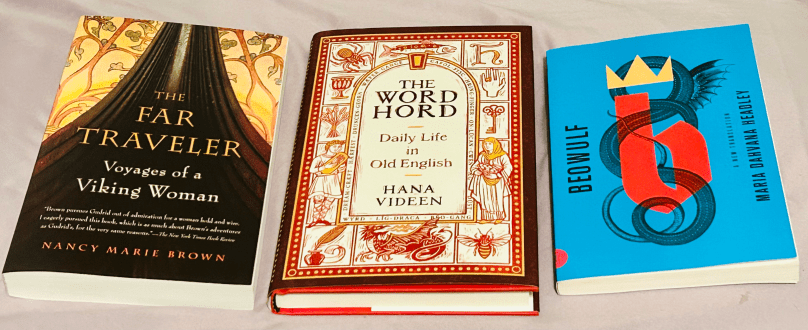
3 books in a row from left to right: The Far Traveler by Nancy Marie Brown, The Word Hord by Hana Videen, Beowulf translated by Maria Dahvana Headley

My Favorite “Heathen-ish” Reads of 2023

I’m starting this off with a disclaimer that none of these books are explicitly “heathen.” They aren’t written for a heathen or pagan audience, nor are they about the religion itself. But they are adjacent, covering areas of history and literature that are interesting to people with heathen leanings. I should also note most of these books are not new, I just happened to read them this year. With that out of the way, here’s some of the best books I read in 2023:

Beowulf, A New Translation by Maria Dahvana Headley

This was barely a 2023 read for me, considering I received it as a holiday gift, but it was a quick read. I have never laughed so hard while reading a Beowulf translation. I’m totally here for the vibes. Perhaps not the most accurate translation of Beowulf on the market (I wouldn’t use it for reconstruction purposes, for sure) but definitely one of the most entertaining. 5/5

The Far Traveler: Voyages of a Viking Woman by Nancy Marie Brown

This book is a mix of travel diary and popular archeology that is certainly interesting. It could be a little slow in places, and it wasn’t as much biography as I was expecting based on the synopsis. Still, it was an enjoyable and interesting read. 3.75/5

Winters in the World by Eleanor Parker

Full disclosure, I haven’t actually finished this one quite yet, but I am enjoying it. The book is of course dealing with Christian Anglo-Saxon England, but there’s still little nuggets there for the interested Fyrnsidere to uncover. As someone who is trying to get back in touch with natural cycles and rhythms, this was an interesting book to dive into.

My 2024 TBR

I also received The Word Hord: Daily Life in Old English by Hana Videen as a holiday gift this year. I haven’t gotten a chance to dive into it just yet, but I am absolutely stoked to do so. Let me know if y’all would like a review of it when I’m finished.

Another book I’m hoping to get to in 2024 is The Darkening Age by Catherine Nixey (I read part of it, but then my library loan expired. Whoops).

I’m always on the hunt for more books to add to my TBR (to be read) pile, so if you have any suggestions, please let me know!