New Year’s Pork Chops & Sauerkraut

By now I think long-time readers are aware that my goal here at Forþ-weard is to support other Fyrnsidera in establishing their modern praxis. To me, a big part of that exploring the holy tides and what modern adaptations and traditions for them could look like. Today, I want to talk about the New Year.

Some Anglo-Saxon heathens will tell you that the new spiritual year begins on Modraniht. Some actually move their celebration of Modraniht to our modern New Year’s Eve to sync up their spiritual new year with the calendar one.1 Personally, I consider the time between Modraniht and New Year’s Eve as a liminal time that doesn’t truly belong to either year, a time aside from the day to day. This is my unverified personal gnosis (UPG) and your mileage may vary. As such, I spread out a lot of my “new years” traditions throughout that period. One such tradition is actually a family tradition I’ve decided to continue: eating pork chops with sauerkraut on New Year’s Day for good luck and prosperity.2

The fact that I continue this tradition is a point of amusement in and of itself. You see, when I was growing up it was often a joke in my family that they would have to disown me over my distaste for sauerkraut. After all, what self-respecting American of strong German ethnic background doesn’t like sauerkraut? Well, me apparently, although I have found a way to prepare it to make my family’s New Year’s Day tradition an enjoyable one for myself.

So, here I am sharing for you my version of New Year’s Pork Chops & Sauerkraut for the one day of the year I actually eat sauerkraut by choice.

Ingredients

1 24oz jar German-style sauerkraut3
4 bone-in pork chops
Salt & pepper to taste
1 medium onion, sliced
1 tsp onion powder
2 bay leaves4
1/2 cup dark brown sugar5
1 tablespoon butter

Instructions

  1. Preheat oven to 350F
  2. Salt and pepper the pork chops. You can also sprinkle some onion powder on them if you’d like.
  3. Brown the pork chops in butter in a pan large enough to lay them out in a single layer.
  4. Remove pork chops and add the onions. Cook until the onions are just translucent.
  5. Add sauerkraut, onion powder, and brown sugar. Combine well and add bay leaves.
  6. Place the pork chops back over the mixture and transfer to oven.
  7. Bake for 15 minutes or until pork chops are cooked through

You can be as magical, or as mundane about this whole affair as you would like. Enjoy! If you happen to make this, I’d love to hear your thoughts.

  1. Byron over at Mine Wyrtruman has a blog post entitled “Beginning the New Year with Mothers Night” that discusses the dating of mother’s night and the Fyrnsidu new year in much greater detail. ↩︎
  2. I have absolutely no idea what the history behind this tradition is or why my family does it, they just always have for as long as I’ve been alive. ↩︎
  3. I use the one from Aldi ↩︎
  4. I started adding these for just a little extra magical prosperity kick, but I also find they add a little something something to the flavor. ↩︎
  5. Light brows sugar works fine, I just think dark gives a nicer color. ↩︎

Observing Winterfylleþ

It’s already late September, and it feels like this year has just flown by. Those of us in the northern hemisphere are officially in what Americans consider to be “fall” (Personally, I prefer “autumn”). For Anglo-Saxon heathens and Fyrnsideras that means Winterfylleþ (Oct 17th) is nearly upon us.

What is Winterfylleþ?

Hence they called the month in which the winter season began “Winterfilleth”, a name made up from “winter” and “full Moon”, because winter began on the full Moon of that month.
De temporum ratione (The Reckoning of Time), The Venerable Bede

We know from the Venerable Bede that the Old English word translates to “Winter Full Moon” and that moon marks the beginning of Winter1… and that’s pretty much all he has to say on the subject. As usual, Bede gives us just enough information to whet the appetite and make some inferences.

For me, Winterfylleþ is one of my four “big” holy days, along with Geol, Ēostredæg, and Midsumor. For me, it is a time for both thanksgiving and propitiation. I consider it to be the beginning of the Wild Hunt, which will end around Geol. I don’t really have strong textual evidence for this last assertion, but I think it is thematically fitting. Many other cultures and pagan paths consider this time between summer and winter to be liminal, the connection between the world of the living and the dead stronger. For example, pagans with a more Celtic lean are getting ready to celebrate Samhain. Norse heathens may be gearing up for Alfablot. In Mexico, the Day of the Dead is celebrated on November 1st, and of course, we can’t forget about Halloween and All Saints Day. Seems to be a running theme, no?

Because we have little textual evidence for how the Anglo-Saxons might have celebrated this hinge in the year, I look to comparative traditions to inform my praxis. And so, my Winterfylleþ celebration will be three nights with three parts:

  1. Welcoming my honored dead and beloved ancestors into my home.
  2. Saying goodbye to seasonal deities who I will welcome back with summer’s return.
  3. Offering to the gods with prayers for a safe and comfortable winter.

Welcoming the Honored Dead

This can be accomplished in several ways. I like to make an offering and invite my ancestors to linger in my home before preparing a nice dinner. The offering could be anything, really, but I often offer my ancestors coffee because most of my known ancestors enjoyed it during their lifetimes. I may also offer my grandfather’s favorite cigarettes or some pipe tobacco this year.

Once dinner is prepared, I will then set aside a portion of the meal at an extra place setting as an offering. (If more of my living family were pagan, I would invite them to this dinner as well, but alas, they are not). I am incapable of being quiet, so I don’t do the silent supper I often see suggested for Samhain. Instead, I prefer sharing stories of loved ones who have gone on before. Telling stories and toasting the memories of our beloved dead is a very Anglo-Saxon heathen thing to do, in my opinion. 

After dinner, an additional libation offering or dessert offering at the altar may be an excellent choice. For me, this is also a good time to break out my oracle deck and see if my ancestors have anything they’d like to communicate with me. I derive a lot of comfort from these talks.

Saying Goodbye to Seasonal Deities

To me, this is a time to say goodbye to Eorthe for the season as she enters her winter slumber, awaiting Eostre’s return in the spring. This year, I will be placing my representations of them in a special place to “rest” until Hrēþe’s victory over Winter in the new year. This is, of course, largely based on my own UPG and SPG I share with others that suggest Eostre and Eorthe grow quieter in the winter months. 

Prayers for a Safe and Comfortable Winter

In our modern world, the harshness of winter often seems softened by electric lights and gas furnaces. However, it doesn’t take much for those luxuries to disappear, if only temporarily. In my part of the world, we’re sometimes one bad storm with blackouts away from freezing. In my mind, it makes sense to make offerings to the gods in hopes that such storms will pass us by and that death stays away for another season.

As previously mentioned, I consider this to be the beginning of the Wild Hunt. Therefore, it is a good time to ask Woden to steer his Hunt away from my door. Frīg is also a major part of my praxis, so I will be asking for her aid in managing my family’s resources well through the winter months. My offerings will consist of grain, wool, whiskey, and incense. It may seem overboard, but as I said, I consider this one of my “big” celebrations.

The gods that you choose to honor for Winterfylleþ may be completely different. Some Norse heathens choose to honor Freyr (Ing in Fyrnsidu) and the elves for Alfablot at this time. Patricia M. Lafayllve’s A Practical Heathen’s Guide to Asatru2 suggests a Winternights ritual honoring the wights, for example.

Final Thoughts

I view Winterfylleþ as a hinge of the year, a beginning and an end. The practices I am building around this holiday reflect this mindset. As time goes by and I grow in my praxis, these things will likely evolve. It will be interesting to look back at this post next year when I’m preparing for the holiday again.

I’d love to hear from you. Do you celebrate Winterfylleþ? Samhain? Something else? Do you have a favorite tradition associated with this time of year? Let me know in the comments!

Photo Credit: Gippe

  1. The Anglo-Saxons, much like their Norse cousins, recognized two seasons or halves of the year, Summer and Winter. What we think of today as Autumn/Fall and Spring are split between the two. Bede also mentions this before explaining Winterfylleþ. ↩︎
  2. Chapter 14 https://bookshop.org/p/books/a-practical-heathen-s-guide-to-asatru-patricia-m-lafayllve/8763949?ean=9780738733876 ↩︎

Further Reading

Ancestor Veneration

Winterfylleþ

A Ritual for Beowa

I was very excited to have another opportunity to write a ritual to Beowa this month. It was my pleasure to introduce some of my friends to this beloved Anglo-Saxon god of barley and beer. Our group includes some very talented bards, and we were blessed with a lovely rendition of John Barleycorn to round out our offerings. Here is a link to a popular version of John Barleycorn on YouTube, in case you’ve never heard the song.

As always, this ritual format assumes you have your own preferences for ritual purification.


For this ritual, you will need:

  • Some sort of flat space for an altar. A table, a big flat rock, a window sill. Doesn’t matter.
  • An image of Beowa
  • Libation offerings. Water or juice is absolutely fine, but I suggest barleywine, beer, or malt whiskey.
  • Something to pour the libations into.
  • Incense (optional). I use loose with charcoal or cones, but whatever type you prefer is just dandy.
  • Candles. LED works just as well.

Good Neighbors (optional)

Note: This section is optional and has been put here in case you are performing this ritual outside or in an unfamiliar space (such as a rented park pavilion).

Good Neighbors, Spirits of this Place
We know that this space is yours
But we ask that you let us borrow it for a while
Join us if our purpose is agreeable
Or leave us in peace for a time

Action: Pour libation for the Good Neighbors outside the space where you will be holding ritual.

Statement of Purpose

At Midsumor we reached a fullness as Sunne reached the height of her power. As the full moon comes only fleetingly each month, so too does summer’s peak last but a moment. The waxing year has ended, and the time of waning has began. And so, the harvests reach their peak and must be gathered in.


Now begins the time of reaping all that we have sown. Many of those seeds of intention we planted in the months following Ewemeolc have grown and blossomed, ripened for the harvest, just like the barley on its golden stalks.


And so tonight, we honor Bēowa, the spirit of the barley.

Action: Light the altar candles

Gatekeeper (optional)

Note: I do not usually acknowledge a gatekeeper in my personal praxis, but I know a lot of people do. So, I chose to include this section for those who may be looking for an appropriate gatekeeper-deity in Fyrnsidu. Other options might include Wadda, Frīg, or even Woden, depending on the purpose of the ritual.

Æled, radiant one, offering-bearer
We ask that you give life to this flame
That it may carry our gifts and prayers
Upon its rising smoke
Open the gate!

Action: Light incense or pour libation offering for Æled.

Invocation

Hail to thee, John Barleycorn.
To the one who is sown, grown and reaped.
You provide us with grain for beer and bread
Good food to fill our bellies and make us merry
Through your birth, life and death
You keep us hale all winter through.

Hail Bēowa!
[All: Hail Bēowa]

Action: Pour a libation of barleywine, beer, or malt whiskey for Beowa

We offer you now beer and barely and song,

A return for that which you have given us,
that you may raise you head again in the spring
and give us good gifts again next year.

Action: Pour an additional libation for Beowa. Sing or play John Barleycorn.

Closing

From the gods, to the earth, to us
From us, to the earth, to the gods
A gift has been given, may be it be well received.

Action: Blow out the candles to indicate the closing of the rite. Dispose of offerings appropriately.

Image Credit: Canva

A Ritual for Midsumor

Look at me being timely with posting a ritual this time! The little cadre of midwestern Fyrnsidera that I met up with for Ēosturdæg are meeting again for Midsumor next week. This time we’re having a cookout and giving thanks to Sunne for the life-giving heat and light she provides.

As usual, this post assumes that you or your group have your own preferences for ritual cleanliness.


For this ritual, you will need:

  • Some sort of flat space for an altar. A table, a big flat rock, a window sill. Doesn’t matter.
  • An image of Sunne (optional, esp if outside)
  • Libation offerings. Water or juice is absolutely fine.
  • Something to pour the libations into.
  • Incense (optional). I use loose with charcoal or cones, but whatever type you prefer is just dandy.
  • Candles. LED works just as well.

Good Neighbors (optional)

Note: This section is optional and has been put here in case you are performing this ritual outside or in an unfamiliar space (such as a rented park pavilion).

Good Neighbors, Spirits of this Place
We know that this space is yours
But we ask that you let us borrow it for a while
Join us if our purpose is agreeable
Or leave us in peace for a time

Action: Pour libation for the Good Neighbors outside the space you will be holding ritual.

Statement of Purpose

Today makes the midpoint in the summer season.
It is a hinge upon which the year turns
From new life and growth to harvest and death
The time of warmth and bounty begins to wane
And so we gather to honor Sunne at the height of her power
Before the cycles of nature pull her distant from us once more.

Action: Light the altar candles

Gatekeeper (optional)

Note: I do not usually acknowledge a gatekeeper in my personal praxis, but I know a lot of people do. So, I chose to include this section for those who may be looking for an appropriate gatekeeper-deity in Fyrnsidu. Other options might include Wadda, Frīg, or even Woden, depending on the purpose of the ritual.

Æled, radiant one, offering-bearer
We ask that you give life to this flame
That it may carry our gifts and prayers
Upon its rising smoke
Open the gate!

Action: Light incense or pour libation offering for Æled.

Invocation

Hail Sunne, brilliant Day Rider, and  Ever-glowing goddess
[All Hail Sunne]

Action: Add incense or pour libation for Sunne.

Your brilliance warms Mother Eorthe’s soil,
Calling forth the green growing things that nourish our bodies.
Today, we celebrate the peak of your glory.
We relish and respect the hot rays of your light,
And adore the feel of your warmth upon our skin,
Even as we protect ourselves from your full might


Accept now our offerings, our praise, and our thanks for the beautiful gift of your light. Remember us, even as the wheel turns and autumn begins to encroach upon our bright summer joy.

Action: Add incense or pour additional libation for Sunne. If in a group, allow time after the main offering for individual prayers and offerings. You may also allow time for additional toasts and/or divination.

Closing

From the gods, to the earth, to us
From us, to the earth, to the gods
A gift has been given, may be it be well received.

Action: Blow out the candles to indicate the closing of the rite. Dispose of offerings appropriately.

A Ritual to Eostre

The spring has just been flying by and I have not been on top of the blog! It seems I blinked and it was Ēosturdæg. The big post I’ve been working on will be delayed, I’m afraid. But, never fear, I do have more content coming. For now, I have a somewhat belated ritual to share with you. I composed following group ritual for a meet-up with other Fyrsideras this weekend. I’m posting it a bit late but there’s no rule that says we can’t hail Ēostre any time besides Ēosturdæg! It’s a little short and sweet but I hope y’all find it helpful.

A few important notes: I am assuming that the individual or group performing the ritual has their own preferences for ritual cleansing, and so jump straight into the hallowing. And while I do not personally include a gatekeeper in my personal praxis, I have included a section for those who do; feel free to skip it. As always, my hallowing and closing are borrowed from my friend Wind in the Worldtree. See my Geol ritual for more ritual notes.


For this ritual you will need:

  • Some sort of flat space for an altar. A table, big flat rock, a window sill. Doesn’t matter.
  • An images of Ēostre (optional)
  • Libation offerings. Water or juice is absolutely fine.
  • Birdseed or similar
  • Something to pour the libations into.
  • Incense (optional). I use loose with charcoal, but whatever type you prefer is just dandy.
  • Candles. LED work just as well.

Hallowing

May the gods guide us,
May our oaths keep us,
May our deeds free us,
May our ancestors aid us always.
May the gods banish from this place ill and wrong,
Hallow this space, shield us from all baneful wights,
Let the gods’ blessing be over our heads!

Action: Walk around the space with a flame such as a candle or lamp as the words are spoken. Light the altar candles.

Statement of Purpose

We have come together today to celebrate the coming of spring, the beginning of a season of warmth and growth. Hrēðe has defeated Old Man Winter, and now Ēostre dances across the land, coaxing all that is green and good from Eorthe’s rich soil.

Gatekeeper

Æled, radiant one, offering-bearer
We ask that you give life to this flame
That it may carry our gifts and prayers
Upon its rising smoke
Open the gate!

Action: Pour a libation or light incense for Æled

Invocation

Hail Ēostre, Bringer of Summer and Bearer of Blossoms

[All: Hail Ēostre]


You bring us to wakefulness with the dawn
As you rouse the Earth from her Winter slumber.
You know the timing of flowers and the dances of bees.

We come before you to celebrate your day,
Grateful for the waking world around us,
For he dandelions that grow plentiful around our feet,
The singing of birds and the buzzing of bees.
And the sweet scent of spring rain before the summer blooms.
We thank you for these signs of the turning season
And the warmer temperatures that bring them.

They are such beautiful gifts that you give us.

A gift calls for a gift, and so now we bring you our humble offerings.

Action: Pour libations and/or scatter birdseed (if outdoors). If in a group, allow time after the main offering for individual prayers and offerings. You may also allow time for additional toasts.

Closing

From the gods, to the earth, to us
From us, to the earth, to the gods
A gift has been given, may it be well received

Action: Blow out candles to signify the end of the ritual and dispose of the offerings appropriately.

The Etymology of Easter, a Primer

I thought it was a bit early to be talking about Ēosturdæg, but Ostara gets celebrated earlier and the nonsense has started on social media already. So, here we are. This was not the post I was intending to write for Ēosturdæg (in fact, I have another one mostly written in drafts) but it is the one I feel compelled to write because I had the misfortune to be scrolling TikTok this morning.

There exists a certain pagan-phobic subset of Christians that refuse to use the word Easter. Some that I knew during my Christian days would stubbornly refuse to call the holiday anything other than “Resurrection Sunday” (despite the fact that other names for the holiday derived from Latin exist). And why would they do this? Because according to them, the word Easter comes from the name of the goddess Ishtar.

It’s funny, because they’re half right. Easter does come from the name of a pagan goddess… but not that one.

To understand the basic etymology of the name and why English speakers generally call the holiday Easter, we need look no further than the Venerable Bede1.

Eosturmonath has a name which is now translated as “Paschal month”, and which was once called after a goddess named Eostre, in whose honor feasts were celebrated in that month. Now they designate that Paschal season by her name, calling the joys of the new rite by the time-honored name of the old observance.

De temporum ratione (The Reckoning of Time), The Venerable Bede

For those unfamiliar with Latin, “Paschal” in this context is the celebration of the death and resurrection of Jesus Christ. In this passage, Bede explains to us that an older English word has been grafted onto this celebration that is now dominate in England at the time of his writing.

So, Ēostre was a goddess in what we now called England who we know existed from this one singular reference from an English monk writing in the 700s CE. She may or may not have had cognates in other Germanic cultures, such as Jacob Grimm’s hypothesized Ostara. Honestly, this is an area of rather fascinating scholarly debate. I will save further discussion of that for my other upcoming post though.

Meanwhile, Ishtar (or Inanna, as she was known to the Sumerians) was a goddess worshiped by various cultures in and around Mesopotamia.2 The name Ishtar comes from Akkadian, a Semitic language.3

The probability that Ishtar influenced the development of Ēostre as a goddess or a linguistic concept in a completely different language family (Indo-European) is incredibly low. The Wiktionary entry for Ishtar even notes that this is a debunked modern folk-etymology.4 But if you want to explore the actual etymology of Ēostre in much greater depth (and gain a terrible headache) I suggest you check out the book I reviewed last month by Philip Shaw.

In conclusion, Easter comes from an Anglo-Saxon name for an Anglo-Saxon goddess that attached to a Christian holiday as a localized name through the normal processes of syncretism and assimilation. While the name may be pagan in origin (if you believe Bede as I do), it has been used in a Christian context for a minimum of 1300 years. If it was good enough for Bede in 725, it’s probably fine. But if you’re going to be weird about words with pagan origins I’ve got some bad news about the days of the week…

Post-Easter Edit

I’ve see so many progressive Christian clergy slandering the Venerable Bede this week that it’s making my head spin. You do not have to accuse Bede of “making shit up” to make the case that the celebration of Easter as we know it is a Christian phenomenon. In case I was not clear above, having the local name stem from a possible pagan goddess does not make the holiday itself pagan. Easter is an entirely Christian holiday and not “stolen” from pagans. That doesn’t invalidate pagans who wish to celebrate Eosturdæg as a day devoted to Eostre or pagans who wish to celebrate the equinox as Ostara. Something doesn’t have to be ancient to be valid.

  1. Bede was a monk who lived from about 672 CE to 735 CE. He wrote an An Ecclesiastical History of the English People, as well The Reckoning of Time, which is the single best source for reconstructing the pagan Anglo-Saxon calendar. Here’s the Wikipedia entry if you want a jumping off point to read more about Bede. ↩︎
  2. Here’s the Wikipedia entry on Inanna if you again want a jumping off point for further reading. ↩︎
  3. Somewhat ironically, “paschal” from the Latin “pascha” actually comes from another language in the same family as Akkadian: Hebrew. ↩︎
  4. https://en.wiktionary.org/wiki/Ishtar ↩︎
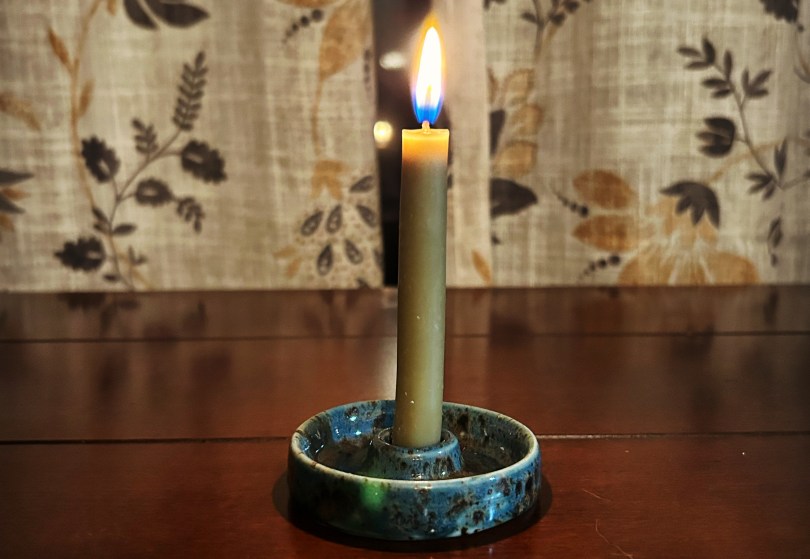
A bayberry candle burning in a ceramic holder

Should Fyrnsideras Celebrate Ewemeolc?

The obvious answer to the title question is that Fyrnsideras can celebrate whatever holy days they want. I’m not your boss. Still, I’d like lay out as best I can the historical basis for an early February festival and why we should—or maybe shouldn’t—call it Ewemeolc.

What is Ewemeolc?

According to most sources, Ewemeolc is a celebration of the lambing seasons and the return of lactation among the animals that Anglo-Saxons and their neighbors relied on. It is the very first celebration of the coming season of abundance after a season of deprivation. To quote Alaric Albertsson, “This is what we celebrate each year at Ewemeolc—renewal and sustenance.”1

Many readers may be completely unfamiliar with this term, or think it sounds suspiciously similar to the name of another pagan holiday, and I can’t really blame them. Researching for this post was, in a word, frustrating. The word “Ewemeolc” does not appear to be widely attested, or even really discussed as far as I can tell. The Venerable Bede, our main source for Anglo-Saxon calendar information, certainly doesn’t mention it at all. Alaric Albertsson lists it as a holy tide in Travels Through Middle Earth quoted above, and every other reference I’ve found so far usually turns out to be citing him. Really, the name is nothing more than a semi-plausible Old English moniker for Imbolc, a celebration of Celtic origin.

Imbolc itself is also somewhat contested, with several theories as to the origin of its name. The most commonly accepted of these today is the idea that Imbolc or Imbolg means “in the belly” and refers to the pregnancy of sheep. Meanwhile, the construction of “Ewemeolc” is based on is a linguistic theory that it meant “Ewe’s milk” from the 10th century that has been discredited.2

With this information we can see that calling the holiday by the name Ewemeolc is a somewhat dubious proposition. It can be argued that there is no need to construct an old sounding name for a reconstruction of a festival that may—or may not—have existed. On the other hand, I have yet to hear anyone suggested a better name for Fyrnsideras to use. But even if we dispatch with the term Ewemeolc, there is no need to throw out the baby with the bathwater; we can still have our early spring festival.

Why Celebrate It?

So, if Ewemeolc isn’t an explicitly attested celebration, why should we consider including it in our sacred calendars?

  1. We do know that the Anglo-Saxons were doing something at that time of year since Bede specifically mentions they offered cakes during Solmōnaþ (roughly February in our calendar).3
  2. Imbolc for all we can debate its etymology is well established as a holiday among modern pagans. A tradition doesn’t have to be old to be valid.

Many Fyrnsideras live in families and communities of mixed traditions. For some of us, a group like the ADF4 provide the only in-person fellowship we can participate in regularly. Finding common ground in our holidays is often a necessity.

Constructing a Fyrnsidish Early Spring Festival

If we want to start with the evidence, we must begin with Bede and his cakes. The hearth cakes of the Anglo-Saxons were more akin to flatbread than what modern readers probably think of when they see “cake.”5 An appropriate modern substitute would probably be some form of oatcake or bannock. (I don’t think the gods would object if you wanted to make a modern cake with tasty buttercream frosting though.)

While digging in to modern Imbolc and Candlemas traditions, another possible modern alternative also caught my eye: pancakes. Personally, I kind of adore the idea of waking up on a chilly February morning and diving into a stack of thick, fluffy buttermilk pancakes. This is also the time of year when trees are tapped for syrup, so it seems very on trend for the season.

Bede tells us nothing about why the cakes were offered, of course. Nor does he give us any indication how those cakes may have differed from the everyday hearth cakes. My personal theory is that they were giving back part of their remaining winter stores to the Earth or some other agricultural deity to ensure the return of spring and the growing season. There was real sacrifice in giving up any part of your food supply this late in the winter.

And so, to go any further in our reconstruction we must look to other celebrations that take place in the early, early spring. Here we can find a few interesting threads to pull: fertility, cleansing, weather prediction, and the increasing light.

Fertility

The source of the sustenance and renewal that Albertsson eloquently discusses in Travels Through Middle Earth is specifically the milk brought about by the lambing seasons, a results of the ewes’ pregnancy. Likewise, this same theme is found in the Imbolc celebrations. It should be noted here that one of the products of this milk—fresh, salty soft cheese—was commonly eaten with hearth cakes. Hmm, did we just solve the mystery of Bede’s cakes?

Many Fyrnsideras do syncretize with Religio Romana, so we can also look to Lupercalia, the Roman festival in mid-February for evidence of a fertility theme. Although, I don’t in any way recommend recreating the Roman method of ensuring human fertility. Getting smacked on the hand with a thong of goat’s hide after it was sacrificed holds zero appeal for me.6

Plutarch also mentions that Lupercalia was said to have been celebrated by shepherds in ancient times (from his perspective). I don’t think this has any bearing on Imbolc celebrations, but I do think it’s a fun coincidence.

Cleansing

Another thread we find in common among other early spring festivals is a focus on purification or cleansing. Spring cleaning continues to be a traditional activity for this time of year into the modern day.

Candlemas, which is a Christian holiday, focuses on the purification of Mary following Jesus’s birth. It’s possible that could have also melded with other local traditions in areas where Candlemas is still celebrated to this day.

Looking back to the Romans again, we also find the February and Lupercalia have cleansing associations.

Weather Prediction

I’ve been calling this an early spring festival, but you could by all rights also say this is a late winter festival. In some places I believe it’s even referred to as midwinter.7 So, spring isn’t really quite here yet with the coming of the lambs. Figuring out just how much longer the winter weather is going to last was therefore top of mind for our agriculturally focused forbearers.

The methods of doing this weather divination vary across the world, and within our geographic areas of concern for our reconstruction purposes. Many involve hibernating animals, while others simply say that foul weather on Imbloc bodes well for an early spring8.

One practice did make its way across the pond to the United States, however. German settlers in Pennsylvania particularly brought with them a custom of looking to a hedgehog or a badger to see what the future weather might hold. Well, their new home didn’t quite have those same animals, and so the tradition of Groundhog’s Day on February 2nd was born.

Goddesses to Honor for Ewemeolc

Pagans of more Celtic leanings often venerate Brigid or St. Brigid during Imbolc. If you are a Fyrnsidere who has some syncretism with Celtic polytheism and venerates Brigid, this may be your go-to. I’m not, so I won’t really go into further detail on that here.

The Earth Mother

I think Mother Earth gives Woden a run for his money when it comes to who has the most names. In Fyrnsidu she is known as Eorthe or Folde. Nerthus and Hludana are names for her from other Germanic traditions. And of course, the Norse call her Jorð. You can find her in Greek traditions as Gaia, and to the Romans she was Terra. Modern druids in the ADF include an invocation to the Earth Mother in every single one of their public rituals.

I think it might be fair to say that Mother Earth or the personification of the Earth is the most widely worshiped entity in modern paganism. In my personal opinion, you could make a case for her being one of the most important deities, because it is through her that we receive many of the gods’ gifts, such as the nourishment for our bodies, the clothes that protect us, and the materials to build our shelters.

At this time of the year in the northern hemisphere, Eorthe is just waking up from her long sleep. Unseen beneath the snow and mud seeds are starting their slow progress towards germination. You could say they are safe in Eorthe’s belly, waiting to be born. Much like the lambs in the bellies of the ewes, no?

Frīg

This is probably a less obvious choice. However, if you venerate Frīg and want to lean into the spring cleaning and human fertility aspects of the season, inviting her to your celebrations just makes sense.

There are several ways to understand Frīg. Personally, I lean more into some of the associations from Norse mythology. I see her as concerned with maintaining order in the home, textile crafts, motherhood, child-bearing, and magic. She is a seer, a weaver of Wyrd and friþ. Beofeld from Wind in the Worldtree has laid out a reconstruction of Anglo-Saxon Frīg that leans more into the Roman interpretatio germanica of her as a Venus figure.9 Beauty, sex, and even war. I don’t actually think this conflicts with my view of her at all, since I see her and the Norse Freyja as the same figure (you can disagree with me, that’s okay).

Suggestions for Celebration

  • Have a paganized Æcerbot10 (if you garden).
  • Have a ritual to bless your gardening tools (if you garden).
  • Have a fertility ritual for your local farmers’ market vendors’ gardens.
  • Have a fertility ritual for yourself and your partner, if that’s something you’re interested in.
  • Consider adding a representation of Eorthe to your altar space if you don’t already have one.
  • Eat and offer goat cheese.
  • Bake little offering cakes or rolls.
  • Have pancakes.
  • Do some weather divination, groundhog or badger optional.
  • Do some spring cleaning
  • Take a ritual bath or an ice bath
  1. Alaric Albertsson, Travels Through Middle Earth, Chapter 10 Holy Tides. ↩︎
  2. The reconstruction is on an older theory of the origin of the word Imbolc, which appears in Cormac’s Glossary. Special thanks to Rob Holman of Ingwine.org for pointing me to this.
    

I did not have time personally track down copies of the correct sources for discrediting it, but the Wikipedia article for Imbolc is extremely well footnoted for those who would like to pursue this further. ↩︎
  3. The Venerable Bede, The Reckoning of Time ↩︎
  4. Ár nDraíocht Féin: A Druid Fellowship ↩︎
  5. The Early English Bread Project explains what Anglo-Saxon bread or hearth cakes were like and how to make your own. ↩︎
  6. Plutarch describes the Lupercalia festivities observed by Ceaser in Life of Ceaser. ↩︎
  7. Bex from The witches’ cookery definitely refers to it as midwinter in her Imbolc videos, which you should definitely check out for some fun, witchy food and craft ideas. ↩︎
  8. Here again the Wikipedia article for Imbolc is well footnoted for this subject. I am not any kind of expert on Imbolc and will not pretend to be. ↩︎
  9. Frīg reconstruction from Wind in the Worldtree. ↩︎
  10. The Æcerbot is an Old English charm from after the Christianization of the Anglo-Saxons that seems to have some pagan undertones. It’s a popular choice for adapting to more pagan language. Here are some examples from Wind in the Worldtree and Silver Well Hearth. ↩︎

Further Reading

Eorthe

Frīg

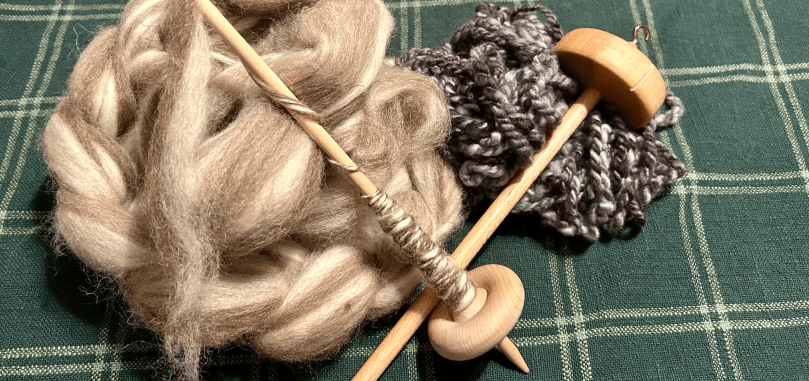
A top-whorl drop spindle and a bottom-whorl drop spindle crossed and resting against brown and cream wool roving and blue-gray hand-spun yarn.

Who Was Going to Tell Me About Distaff Day?

My first post for Forþ-weard was about about tailoring your personal sacred calendar to your own praxis. Well, I have a new example for you happening in my own praxis in real time.

I recently—as in, during the last 48 hours—learned of the concept of Distaff Day (this is the part where you can all point and laugh at the silly American). Anyway, as someone whose praxis is largely dominated by Frīg, I am enamoured of this concept. Now, as far as I’m aware, this holiday is wholly Christian in origin1, being the day following the feast of the Epiphany, but it’s also been taken up secularly by people in fiber arts communities (which is how I came to learn of it)2.

In continuing on with that first post about fleshing out your own holiday calendar, I’m thinking I want to find some ways to incorporate Distaff Day into my rotation. Here are the traditions I’m considering starting for myself:

  • I didn’t spin at all during Geol this year more out of coincidence than conscious choice, but I’m thinking having an intentional fiber arts hiatus from Mother’s Night through Distaff Day in the future. There’s precedence for this practice, too.3
  • Scheduling a vacation day from work if January 7th happens to fall during the week and I have the time available.
  • Designating Distaff Day as when I will begin my first project of the new year.
  • Making an offering of my first spun yarn of the new year to ask Frīg’s blessing on my new endeavors.
  • Joining a local yarn spinning event, class or workshop that day if one is available.
  • Treating myself to a new distaff or spindle if needed4

These may seem like small things, but recently I’ve decided that I want to get more serious about devotional craft work—and just generally becoming better at spinning. I love the idea of formalizing and ritualizing the beginning of my crafting year just a little bit to help me in these goals.

So, who wants to join me in celebrating a heathen-ified version of Distaff Day? Let me know if you have any other ideas on how we could celebrate!

  1. If I’m wrong about this, please feel free to point me to some sources in the comments. I’d love to see them! ↩︎
  2. Specifically, I saw this video on YouTube by JillianEve. ↩︎
  3. Jacob Grimm states in Teutonic Mythology V.1 that “In the North too, from Yule-day to New-year’s day, neither wheel nor windlass must go round.” ↩︎
  4. I don’t actually own a distaff of any kind at the moment, and it’s something of a hinderance to my progress with my drop spindles. ↩︎
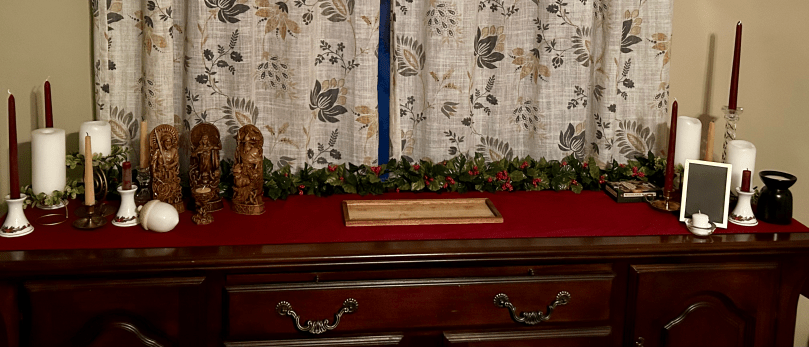
A sideboard with a deep red table runner. Each end has red, white and natural beeswax candles. On the left are statues of Ing, Frig, and Woden. On the right is a picture frame with black paper in it and a wax warmer.

A Ritual for Geol

The following is a ritual to Frīg and Woden that I recently composed for a group Geol celebration. It can easily be adapted for a solo practitioner by replacing some plural pronouns and optionally dropping the Statement of Purpose section. Originally, I wrote the ritual to fit the requirements for my local mixed-faith group, but this version is stripped down to what I would consider the necessary components for a Fyrnsidere’s praxis. And yes, this ritual has footnotes, haha. I’ve also included a further reading section for more information about ritual format in Fyrnsidu and Anglo-Saxon heathenry. Please note that how I structure my rituals may vary from the sources I’ve linked to. Every individual and group’s praxis will look a little different. Please feel free to adapt this to your needs.


For this ritual you will need:

  • Some sort of flat space for an altar. A table, big flat rock, a window sill. Doesn’t matter.
  • Images of Frīg and Woden (optional)
  • Libation offerings. Water or juice is absolutely fine.
  • Something to pour the libations into.
  • Incense (optional). I use loose with charcoal, but whatever type you prefer is just dandy.
  • Candles. LED work just as well.

Hallowing1

May the gods guide us,
May our oaths keep us,
May our deeds free us,
May our ancestors aid us always.
May the gods banish from this place ill and wrong,
Hallow this space, shield us from all baneful wights,
Let the gods’ blessing be over our heads!2

Action: Walk around the space with a flame such as a candle or lamp as the words are spoken. Light the altar candles.

Statement of Purpose

As the year wanes, Sunne’s light grows faint. The nights loom long as her strength fades. In the lengthened shadows, the Wild Hunt rides. And in this liminal time we gather as our ancestors did, pushing away winter’s chill in the warmth of fire and frith. We anticipate Sunne’s triumphant return, and give thanks to Woden & Frīg that the death has passed us by another year. Together we make merry and give good gifts, that we may bring the light of joy into this cold midwinter night. 

Gatekeeper3

Æled4, radiant one, offering-bearer
We ask that you give life to this flame
That it may carry our gifts and prayers
Upon its rising smoke
Open the gate!

Action: Pour a libation or light incense for Æled

Invitations

Good neighbors, we call to you. This land is cold and sleeping. The nights have grown long and chill. We invite all spirits of good will who dwell here to join us at our fire and feast with us at our table. Be merry with us in this place of frith.
Hail the Landwights!
(All: Hail the Landwights!)

Honored ones who have gone before us. Beloved ancestors of body and of spirit, we call to you through the generations, back into the mists of time. As the wild hunt rides and the veil is thin, we invite you to our fire. Feast with us, laugh with us. Celebrate with us on this longest night.
Hail our Honored Ancestors!
(All: Hail our Honored Ancestors!)

Hail the Gods and Goddesses, the mighty ones. The year is dying, and it is time we remember your many gifts. Join us at our fire and feast. Receive what we have brought for you. Hear our words of thanks and witness our oaths.
Hail the Gods and Goddesses!
(All: Hail the Gods and Goddesses!)

Action: Pour a small libation for each group as they are invited in.

Main Invocations

Hail to the Heorþmōdor, blessed Hearth-mother, Frīg
Hail to the weaver of frith and weaver of wyrd
Come sit at our table and weave your peace amongst us
That we may strengthen our bonds.
Hail Frīg!
(All: Hail Frīg)

Action: Present offerings for Frīg. Suggestion: a fruit wine.

Hail to the Hygeferigend, wise Soul-Bearer, Woden.
Hail to the wander on his mighty steed
Shake the snow from your cloak and hang it by the fire (or heater)
Let us fill your cup and heap your plate.
Hail Woden!
(All: Hail Woden!)

Action: Present offerings for Woden. Suggestions: whiskey or brandy. And of course, mead is an excellent choice.

Closing

From the gods, to the earth, to us
From us, to the earth, to the gods
A gift has been given, may it be well received 5

Þa godas bletsien eow þissum geare. Glæd Gēol!6

Action: Blow out candles to signify the end of the ritual and dispose of the offerings appropriately.

  1. I am making the assumption here that the reader has their own preferences for cleansing and am jumping straight to the hallowing. ↩︎
  2. This section has been borrowed from Wind in the Worldtree. ↩︎
  3. I personally don’t usually include a gatekeeper when doing private offerings by myself, but I wanted to include this for others who may find this step important. ↩︎
  4. Æled is a reconstruction, a best guess at a sacred fire deity based on the language, how we believe fire was thought of, and comparative study of other Indo-European religions. I think he makes the most sense to use as a gatekeeper in this context. Pronunciation: IPA /ˈæː.led/. Æ is pronounced like the ‘a’ in ‘mat’ and the e is pronounced like ‘ay’ in ‘may’. Read more at Wind in the Worldtree. ↩︎
  5. This is also borrowed from Wind in the Worldtree ↩︎
  6. Old English for “May the gods blessings be upon you [all] this year. Glad Geol.” Credit to T Patrick Snyder for the OE translation. ↩︎

Further Reading

Anglo-Saxon Heathen Ritual Format

Bonus Reading Suggestions

Finding Your Holy Days

One of the interesting and—dare I say it—fun things about developing your own pagan practice is deciding what holy days you will mark and how to celebrate each occasion. Just choosing which days to observe—never mind the how—there exists a dizzying array of choices. Odds are that you will not observe exactly the same holidays as another pagan in your social circle, even if you nominally follow the same tradition. (If you doubt me, just look up the Anglo-Saxon and Norse heathen debates on the correct dating of Gēol/Yule). Because of this, I think it is important to note that you do not have to observe every holiday ever conceived of. You do not have to observe a holy day just because it has historical attestation, nor because it’s what “all the other [x] pagans do.”

Personally, I don’t celebrate all the holidays on the common Wheel of the Year, nor all the holidays you might find listed by various heathen organizations. My big holidays for the year are as follows:

  • Ēosturdæg
  • Midsumor
  • Winterfylleþ
  • Módraniht/Gēol

I list Modraniht and Gēol together because Modraniht is very much a subsection of the ongoing Gēol festivities for me that take up the entire month of December. In fact, you could almost say that Winterfylleþ kicks off my Gēol season, and Modraniht is my early New Year. But as you can see, this is a very abbreviated calendar compared to other lists you may find. They also line-up in time and culture with big observances going on around me: Easter, Halloween, and Christmas. Which brings me to my next point…

Modern Observances

It’s also okay to weave in wholly modern observations. Sometimes the old holy days just don’t quite line up with the schedules and rhythms of our modern lives, especially for those of us who aren’t deeply connected to agriculture. Incorporating our heathenry into holidays our culture is already celebrating is a great way to start knitting these pieces of our identities together. For example, I have been trying to work the secular Earth Day into my own spiritual calendar. Is there an attested Eorthedæg in Anglo-Saxon heathenry? Not that I’m aware of. But there’s certainly enough precedence for the worship of an Earth Mother. To me, it makes sense to dedicate time to this important figure, and lining it up with a pre-existing modern secular holiday makes sense.

Here’s some ideas for other modern holidays (as observed in the US) that you could give a heathen spin:

Earth Day – A húsel or blot to Eorthe or another earth mother goddess is an obvious option. Perhaps less obvious is signing up for some volunteer opportunities and showing the goddess your love through service. Park cleanups and tree plantings can be fun events that help tie you not only to the Earth, but also to your local community.

Mother’s Day / Father’s Day – These holidays are an excellent opportunity to incorporate ancestor veneration into your praxis. A húsel celebrating the mothers/fathers from which you come can be a lovely way to mark the occasion. You could hold a symbel and give everyone an opportunity to share stories about Great-Grandma Evie and Great Aunt Maude. Even if your living family do not share your faith, you can still give an offering on your own. 

Memorial Day – Particularly if you come from a military family, Memorial Day can be a wonderful time to incorporate ancestor veneration. You could also petition gods and ancestors for peace in ongoing conflicts. Many of us do this regularly anyway, but Memorial Day may be a time for special emphasis. Deities to consider might be Twi, Woden, or Hella.

Valentine’s Day or Sweetest’s Day – These days can be made into an opportunity to honor a god or goddess of love. Perhaps an offering to Frīg? Or if you’re of the witchy persuasion, maybe a spell or ritual to spice up the bedroom (with your partner’s consent, of course).

This is hardly an exhaustive list, of course, and rather US centric, but the principle applies to any special observation, really.

Timing & Dates

Depending on how heavily you get into reconstruction, determining the date of certain holidays can be… fraught. My advice to you is to decide how much you care about historical accuracy vs what fits into your life. Personally, I’m fairly confident that the gods are happy that you make offerings around the time of certain observances, regardless of whether you do it Tuesday or Thursday.

If you want to celebrate Gēol on December 21st every year, regardless of the exact date of the astronomical solstice, go for it. If you would prefer to celebrate Gēol on the 25th when the rest of your family is observing Christmas, I think that’s grand, too. (For the record, not all Christians agree on the dates of some of their holidays either and calculating Easter used to be basically a science).

So what holy days do I observe?

Putting all of this together, here’s how my spiritual calendar has shaped up:

  • Ēosturdæg – Full Moon following the Vernal Equinox
  • Arbor Day/Earth Day
  • Mother’s Day 
  • Father’s Day 
  • Midsommer – Summer Solstice (Around June 21st)
  • Winterfylleþ – Full Moon following the Autumn Equinox
  • Módraniht – (Around December 20th)
  • Gēola – Winter Solstice (Around December 21st)

As you can see, it’s a mix of shifting and fixed dates, historical and modern observances. I don’t mind working out the shifting holidays and making plans around them, so that’s what I do.

But I want to hear from you. What holidays do you incorporate into your spiritual calendar? What’s one of your favorite traditions? Tell me in the comments!


Suggested Reading

This may seem like an Albertsson heavy recommendation list, but he was extra relevant!