New Year’s Pork Chops & Sauerkraut

By now I think long-time readers are aware that my goal here at Forþ-weard is to support other Fyrnsidera in establishing their modern praxis. To me, a big part of that exploring the holy tides and what modern adaptations and traditions for them could look like. Today, I want to talk about the New Year.

Some Anglo-Saxon heathens will tell you that the new spiritual year begins on Modraniht. Some actually move their celebration of Modraniht to our modern New Year’s Eve to sync up their spiritual new year with the calendar one.1 Personally, I consider the time between Modraniht and New Year’s Eve as a liminal time that doesn’t truly belong to either year, a time aside from the day to day. This is my unverified personal gnosis (UPG) and your mileage may vary. As such, I spread out a lot of my “new years” traditions throughout that period. One such tradition is actually a family tradition I’ve decided to continue: eating pork chops with sauerkraut on New Year’s Day for good luck and prosperity.2

The fact that I continue this tradition is a point of amusement in and of itself. You see, when I was growing up it was often a joke in my family that they would have to disown me over my distaste for sauerkraut. After all, what self-respecting American of strong German ethnic background doesn’t like sauerkraut? Well, me apparently, although I have found a way to prepare it to make my family’s New Year’s Day tradition an enjoyable one for myself.

So, here I am sharing for you my version of New Year’s Pork Chops & Sauerkraut for the one day of the year I actually eat sauerkraut by choice.

Ingredients

1 24oz jar German-style sauerkraut3
4 bone-in pork chops
Salt & pepper to taste
1 medium onion, sliced
1 tsp onion powder
2 bay leaves4
1/2 cup dark brown sugar5
1 tablespoon butter

Instructions

  1. Preheat oven to 350F
  2. Salt and pepper the pork chops. You can also sprinkle some onion powder on them if you’d like.
  3. Brown the pork chops in butter in a pan large enough to lay them out in a single layer.
  4. Remove pork chops and add the onions. Cook until the onions are just translucent.
  5. Add sauerkraut, onion powder, and brown sugar. Combine well and add bay leaves.
  6. Place the pork chops back over the mixture and transfer to oven.
  7. Bake for 15 minutes or until pork chops are cooked through

You can be as magical, or as mundane about this whole affair as you would like. Enjoy! If you happen to make this, I’d love to hear your thoughts.

  1. Byron over at Mine Wyrtruman has a blog post entitled “Beginning the New Year with Mothers Night” that discusses the dating of mother’s night and the Fyrnsidu new year in much greater detail. ↩︎
  2. I have absolutely no idea what the history behind this tradition is or why my family does it, they just always have for as long as I’ve been alive. ↩︎
  3. I use the one from Aldi ↩︎
  4. I started adding these for just a little extra magical prosperity kick, but I also find they add a little something something to the flavor. ↩︎
  5. Light brows sugar works fine, I just think dark gives a nicer color. ↩︎
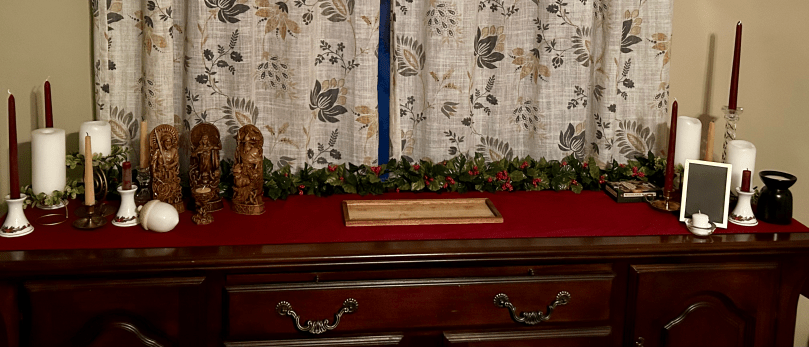
A sideboard with a deep red table runner. Each end has red, white and natural beeswax candles. On the left are statues of Ing, Frig, and Woden. On the right is a picture frame with black paper in it and a wax warmer.

A Ritual for Geol

The following is a ritual to Frīg and Woden that I recently composed for a group Geol celebration. It can easily be adapted for a solo practitioner by replacing some plural pronouns and optionally dropping the Statement of Purpose section. Originally, I wrote the ritual to fit the requirements for my local mixed-faith group, but this version is stripped down to what I would consider the necessary components for a Fyrnsidere’s praxis. And yes, this ritual has footnotes, haha. I’ve also included a further reading section for more information about ritual format in Fyrnsidu and Anglo-Saxon heathenry. Please note that how I structure my rituals may vary from the sources I’ve linked to. Every individual and group’s praxis will look a little different. Please feel free to adapt this to your needs.


For this ritual you will need:

  • Some sort of flat space for an altar. A table, big flat rock, a window sill. Doesn’t matter.
  • Images of Frīg and Woden (optional)
  • Libation offerings. Water or juice is absolutely fine.
  • Something to pour the libations into.
  • Incense (optional). I use loose with charcoal, but whatever type you prefer is just dandy.
  • Candles. LED work just as well.

Hallowing1

May the gods guide us,
May our oaths keep us,
May our deeds free us,
May our ancestors aid us always.
May the gods banish from this place ill and wrong,
Hallow this space, shield us from all baneful wights,
Let the gods’ blessing be over our heads!2

Action: Walk around the space with a flame such as a candle or lamp as the words are spoken. Light the altar candles.

Statement of Purpose

As the year wanes, Sunne’s light grows faint. The nights loom long as her strength fades. In the lengthened shadows, the Wild Hunt rides. And in this liminal time we gather as our ancestors did, pushing away winter’s chill in the warmth of fire and frith. We anticipate Sunne’s triumphant return, and give thanks to Woden & Frīg that the death has passed us by another year. Together we make merry and give good gifts, that we may bring the light of joy into this cold midwinter night. 

Gatekeeper3

Æled4, radiant one, offering-bearer
We ask that you give life to this flame
That it may carry our gifts and prayers
Upon its rising smoke
Open the gate!

Action: Pour a libation or light incense for Æled

Invitations

Good neighbors, we call to you. This land is cold and sleeping. The nights have grown long and chill. We invite all spirits of good will who dwell here to join us at our fire and feast with us at our table. Be merry with us in this place of frith.
Hail the Landwights!
(All: Hail the Landwights!)

Honored ones who have gone before us. Beloved ancestors of body and of spirit, we call to you through the generations, back into the mists of time. As the wild hunt rides and the veil is thin, we invite you to our fire. Feast with us, laugh with us. Celebrate with us on this longest night.
Hail our Honored Ancestors!
(All: Hail our Honored Ancestors!)

Hail the Gods and Goddesses, the mighty ones. The year is dying, and it is time we remember your many gifts. Join us at our fire and feast. Receive what we have brought for you. Hear our words of thanks and witness our oaths.
Hail the Gods and Goddesses!
(All: Hail the Gods and Goddesses!)

Action: Pour a small libation for each group as they are invited in.

Main Invocations

Hail to the Heorþmōdor, blessed Hearth-mother, Frīg
Hail to the weaver of frith and weaver of wyrd
Come sit at our table and weave your peace amongst us
That we may strengthen our bonds.
Hail Frīg!
(All: Hail Frīg)

Action: Present offerings for Frīg. Suggestion: a fruit wine.

Hail to the Hygeferigend, wise Soul-Bearer, Woden.
Hail to the wander on his mighty steed
Shake the snow from your cloak and hang it by the fire (or heater)
Let us fill your cup and heap your plate.
Hail Woden!
(All: Hail Woden!)

Action: Present offerings for Woden. Suggestions: whiskey or brandy. And of course, mead is an excellent choice.

Closing

From the gods, to the earth, to us
From us, to the earth, to the gods
A gift has been given, may it be well received 5

Þa godas bletsien eow þissum geare. Glæd Gēol!6

Action: Blow out candles to signify the end of the ritual and dispose of the offerings appropriately.

  1. I am making the assumption here that the reader has their own preferences for cleansing and am jumping straight to the hallowing. ↩︎
  2. This section has been borrowed from Wind in the Worldtree. ↩︎
  3. I personally don’t usually include a gatekeeper when doing private offerings by myself, but I wanted to include this for others who may find this step important. ↩︎
  4. Æled is a reconstruction, a best guess at a sacred fire deity based on the language, how we believe fire was thought of, and comparative study of other Indo-European religions. I think he makes the most sense to use as a gatekeeper in this context. Pronunciation: IPA /ˈæː.led/. Æ is pronounced like the ‘a’ in ‘mat’ and the e is pronounced like ‘ay’ in ‘may’. Read more at Wind in the Worldtree. ↩︎
  5. This is also borrowed from Wind in the Worldtree ↩︎
  6. Old English for “May the gods blessings be upon you [all] this year. Glad Geol.” Credit to T Patrick Snyder for the OE translation. ↩︎

Further Reading

Anglo-Saxon Heathen Ritual Format

Bonus Reading Suggestions

Finding Your Holy Days

One of the interesting and—dare I say it—fun things about developing your own pagan practice is deciding what holy days you will mark and how to celebrate each occasion. Just choosing which days to observe—never mind the how—there exists a dizzying array of choices. Odds are that you will not observe exactly the same holidays as another pagan in your social circle, even if you nominally follow the same tradition. (If you doubt me, just look up the Anglo-Saxon and Norse heathen debates on the correct dating of Gēol/Yule). Because of this, I think it is important to note that you do not have to observe every holiday ever conceived of. You do not have to observe a holy day just because it has historical attestation, nor because it’s what “all the other [x] pagans do.”

Personally, I don’t celebrate all the holidays on the common Wheel of the Year, nor all the holidays you might find listed by various heathen organizations. My big holidays for the year are as follows:

  • Ēosturdæg
  • Midsumor
  • Winterfylleþ
  • Módraniht/Gēol

I list Modraniht and Gēol together because Modraniht is very much a subsection of the ongoing Gēol festivities for me that take up the entire month of December. In fact, you could almost say that Winterfylleþ kicks off my Gēol season, and Modraniht is my early New Year. But as you can see, this is a very abbreviated calendar compared to other lists you may find. They also line-up in time and culture with big observances going on around me: Easter, Halloween, and Christmas. Which brings me to my next point…

Modern Observances

It’s also okay to weave in wholly modern observations. Sometimes the old holy days just don’t quite line up with the schedules and rhythms of our modern lives, especially for those of us who aren’t deeply connected to agriculture. Incorporating our heathenry into holidays our culture is already celebrating is a great way to start knitting these pieces of our identities together. For example, I have been trying to work the secular Earth Day into my own spiritual calendar. Is there an attested Eorthedæg in Anglo-Saxon heathenry? Not that I’m aware of. But there’s certainly enough precedence for the worship of an Earth Mother. To me, it makes sense to dedicate time to this important figure, and lining it up with a pre-existing modern secular holiday makes sense.

Here’s some ideas for other modern holidays (as observed in the US) that you could give a heathen spin:

Earth Day – A húsel or blot to Eorthe or another earth mother goddess is an obvious option. Perhaps less obvious is signing up for some volunteer opportunities and showing the goddess your love through service. Park cleanups and tree plantings can be fun events that help tie you not only to the Earth, but also to your local community.

Mother’s Day / Father’s Day – These holidays are an excellent opportunity to incorporate ancestor veneration into your praxis. A húsel celebrating the mothers/fathers from which you come can be a lovely way to mark the occasion. You could hold a symbel and give everyone an opportunity to share stories about Great-Grandma Evie and Great Aunt Maude. Even if your living family do not share your faith, you can still give an offering on your own. 

Memorial Day – Particularly if you come from a military family, Memorial Day can be a wonderful time to incorporate ancestor veneration. You could also petition gods and ancestors for peace in ongoing conflicts. Many of us do this regularly anyway, but Memorial Day may be a time for special emphasis. Deities to consider might be Twi, Woden, or Hella.

Valentine’s Day or Sweetest’s Day – These days can be made into an opportunity to honor a god or goddess of love. Perhaps an offering to Frīg? Or if you’re of the witchy persuasion, maybe a spell or ritual to spice up the bedroom (with your partner’s consent, of course).

This is hardly an exhaustive list, of course, and rather US centric, but the principle applies to any special observation, really.

Timing & Dates

Depending on how heavily you get into reconstruction, determining the date of certain holidays can be… fraught. My advice to you is to decide how much you care about historical accuracy vs what fits into your life. Personally, I’m fairly confident that the gods are happy that you make offerings around the time of certain observances, regardless of whether you do it Tuesday or Thursday.

If you want to celebrate Gēol on December 21st every year, regardless of the exact date of the astronomical solstice, go for it. If you would prefer to celebrate Gēol on the 25th when the rest of your family is observing Christmas, I think that’s grand, too. (For the record, not all Christians agree on the dates of some of their holidays either and calculating Easter used to be basically a science).

So what holy days do I observe?

Putting all of this together, here’s how my spiritual calendar has shaped up:

  • Ēosturdæg – Full Moon following the Vernal Equinox
  • Arbor Day/Earth Day
  • Mother’s Day 
  • Father’s Day 
  • Midsommer – Summer Solstice (Around June 21st)
  • Winterfylleþ – Full Moon following the Autumn Equinox
  • Módraniht – (Around December 20th)
  • Gēola – Winter Solstice (Around December 21st)

As you can see, it’s a mix of shifting and fixed dates, historical and modern observances. I don’t mind working out the shifting holidays and making plans around them, so that’s what I do.

But I want to hear from you. What holidays do you incorporate into your spiritual calendar? What’s one of your favorite traditions? Tell me in the comments!


Suggested Reading

This may seem like an Albertsson heavy recommendation list, but he was extra relevant!