New Year’s Pork Chops & Sauerkraut

By now I think long-time readers are aware that my goal here at Forþ-weard is to support other Fyrnsidera in establishing their modern praxis. To me, a big part of that exploring the holy tides and what modern adaptations and traditions for them could look like. Today, I want to talk about the New Year.

Some Anglo-Saxon heathens will tell you that the new spiritual year begins on Modraniht. Some actually move their celebration of Modraniht to our modern New Year’s Eve to sync up their spiritual new year with the calendar one.1 Personally, I consider the time between Modraniht and New Year’s Eve as a liminal time that doesn’t truly belong to either year, a time aside from the day to day. This is my unverified personal gnosis (UPG) and your mileage may vary. As such, I spread out a lot of my “new years” traditions throughout that period. One such tradition is actually a family tradition I’ve decided to continue: eating pork chops with sauerkraut on New Year’s Day for good luck and prosperity.2

The fact that I continue this tradition is a point of amusement in and of itself. You see, when I was growing up it was often a joke in my family that they would have to disown me over my distaste for sauerkraut. After all, what self-respecting American of strong German ethnic background doesn’t like sauerkraut? Well, me apparently, although I have found a way to prepare it to make my family’s New Year’s Day tradition an enjoyable one for myself.

So, here I am sharing for you my version of New Year’s Pork Chops & Sauerkraut for the one day of the year I actually eat sauerkraut by choice.

Ingredients

1 24oz jar German-style sauerkraut3
4 bone-in pork chops
Salt & pepper to taste
1 medium onion, sliced
1 tsp onion powder
2 bay leaves4
1/2 cup dark brown sugar5
1 tablespoon butter

Instructions

  1. Preheat oven to 350F
  2. Salt and pepper the pork chops. You can also sprinkle some onion powder on them if you’d like.
  3. Brown the pork chops in butter in a pan large enough to lay them out in a single layer.
  4. Remove pork chops and add the onions. Cook until the onions are just translucent.
  5. Add sauerkraut, onion powder, and brown sugar. Combine well and add bay leaves.
  6. Place the pork chops back over the mixture and transfer to oven.
  7. Bake for 15 minutes or until pork chops are cooked through

You can be as magical, or as mundane about this whole affair as you would like. Enjoy! If you happen to make this, I’d love to hear your thoughts.

  1. Byron over at Mine Wyrtruman has a blog post entitled “Beginning the New Year with Mothers Night” that discusses the dating of mother’s night and the Fyrnsidu new year in much greater detail. ↩︎
  2. I have absolutely no idea what the history behind this tradition is or why my family does it, they just always have for as long as I’ve been alive. ↩︎
  3. I use the one from Aldi ↩︎
  4. I started adding these for just a little extra magical prosperity kick, but I also find they add a little something something to the flavor. ↩︎
  5. Light brows sugar works fine, I just think dark gives a nicer color. ↩︎
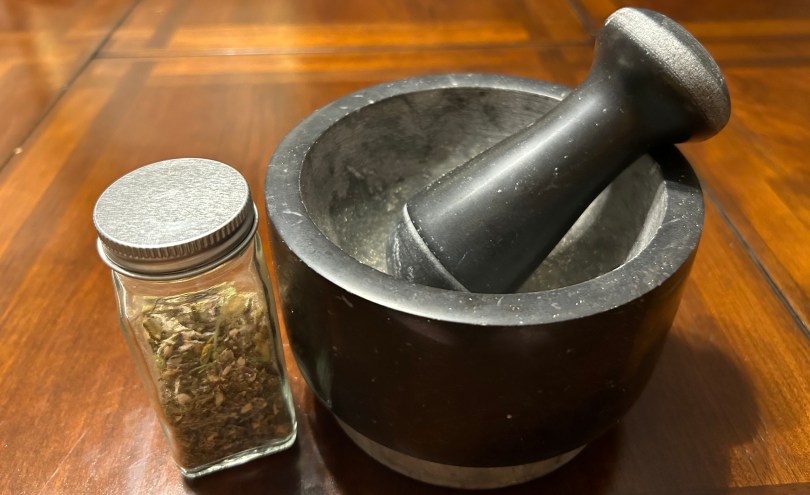
A spice jar of incense and a black stone mortar and pestle.

Nine Herb Charm Incense

Disclaimer: I AM NOT AN EXPERT. Do not touch, consume, burn, or otherwise mess with any plant you are unfamiliar with. Consult an actual herbalist or your doctor. For all the gods’ sakes, please exercise caution and common sense when working with herbs. Always burn incense in a well-ventilated space away from pets.


One of the rather frustrating things about reconstructing Anglo-Saxon paganism is the lack of written sources. What sources we do have were written in the centuries after conversion and tend to provide only tantalizing hints about what might have been. One such piece of writing is the “Nine Herb Charm,” a medical text that describes the use of a combination of, you guessed it, nine plants in a salve along with a lengthy verbal component.1

Were these nine plants the most sacred plants in Anglo-Saxon paganism? We don’t know. Heck, we’re not even 100% sure what some of them actually are. But, the Nine Herb Charm provides all sorts of interesting glimpses into the Anglo-Saxon pagan mind. For example, it mentions “the seven worlds,” informing us just a little about the Anglo-Saxon sense of cosmology.

Since the Nine Herbs are described—at length—to drive out poison and illness, I thought it would make perfect sense to adapt them into an incense recipe for cleansing during formal rituals.

Nine Herb Charm Incense

  • 1 part dried Mugwort
  • 1 part dried Plantain leaves
  • 1 part dried Bittercress
  • 1 part dried Betony
  • 1 part dried Chamomile flowers
  • 1 part dried Stinging Nettle
  • 1 part Applewood shavings
  • 1 part dried Parsley
  • 1 part Fennel seeds

I ordered everything except the parsley and applewood from an herb shop on Etsy. The parsley came from my pantry, and I shaved bits off a piece of the applewood my husband keeps around for his smoker. From there, I measured everything with a teaspoon into my mortar and gave it all a good smash to break up the big bits. This yielded me about half a spice jar of incense.

Guesses & Substitutions

Scholars aren’t entirely sure about the identity of some of the plants. Attorlaðe, for example, is unknown but thought by many to be woody betony.2 I did see someone claim that this plant was black nightshade, which I would not recommend. Cockspur grass is another common interpretation. I chose betony.

The next questionable interpretation is for “lamb’s cress.” Some people take it to mean watercress, while others say hairy bittercress or Cardamine hirsuta.3 I opted to use Cardamine bulbosa, a close relative to hair bittercress that is native to North America.4

My next swap is the applewood shavings. In the charm, they seem to be using a mash made of crabapples. I suppose I could have gotten my hands on some crabapples and dried their skin or something, but I think using a bit of applewood actually makes more sense for incense, especially given that the wood was intended for a smoker anyway.

And finally, there is the parsley. Some scholars believe that fille in the charm refers to chervil or a similar plant.5 Chervil is related to parsley,6 which is much more readily available in my local grocery store. Patti Wiggington uses thyme in her Nine Herb Charm salve.7

Don’t forget a good chant

I also wrote a little galdor to go with it because why not? The original charm had a verbal component, after all.

Nine herbs sacred burn and smoke
Remember all which past you smote
Drive out illness, malice, and pain
Clear this space of the profane.

Conclusion

Is this an exact replica of what was used in Anglo-Saxon times? Definitely not. But do I think it will make the right connections and enhance my praxis? Absolutely.

Let me know in the comments if you have a different Nine Herbs blend that you favor. I’d love to know!

  1. Read a translation here https://www.mimisbrunnr.info/nigon-wyrta-galdor ↩︎
  2. I went with betony, which is listed here: https://heorot.dk/woden-9herbs.html. However, you can find a couple of alternative suggested plants here https://www.herbalhistory.org/home/the-nine-herbs-charm-plants-poisons-and-poetry/ ↩︎
  3. https://www.mimisbrunnr.info/nigon-wyrta-galdor#wyrts ↩︎
  4. https://en.wikipedia.org/wiki/Cardamine_bulbosa ↩︎
  5. https://www.mimisbrunnr.info/nigon-wyrta-galdor#wyrts ↩︎
  6. https://en.wikipedia.org/wiki/Chervil ↩︎
  7. https://www.pattiwigington.com/saturday-spellwork-the-9-herbs-charm/ ↩︎

Sorry if I got a little lazy on the footnotes this time, y’all.

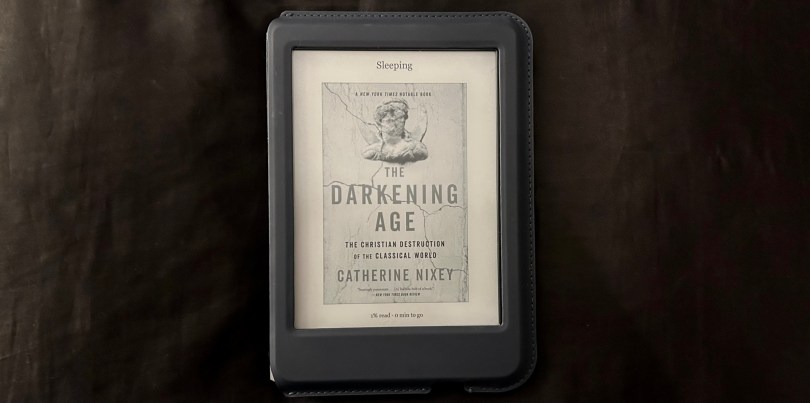
Book Review: The Darkening Age

The Darkening Age: The Christian Destruction of the Classical World by Catherine Nixey takes the story of Christianity’s “triumph” and turns it on its head. The reader is taken on a journey through time where, piece by piece, the pagan Roman world is transformed.

I had always assumed that the rough condition of many ancient statues was primarily a function of age and rough handling by people who did not understand their value. Likewise, I attributed all of the lost literature to time, war, natural disasters, and general human carelessness. I’m sure those factors played a part, but I did not realize how much purposeful destruction was wreaked upon Greek and Roman art during Christianity’s rise to power. I suppose it really should not have surprised me.

After my initial shock, the primary emotions I felt throughout this book were an ebb and flow of grief and rage. For each thing preserved from ancient Rome, a hundred more were destroyed. How many great works of art, literature, and science did we lose? How many decades or even centuries of advancement did they hobble? It saddens me to think of all the books we’ll never read because some preacher or bishop decided to burn them.

Some may find Nixey’s condemnation of the early church heavy-handed, perhaps even a little rage-baity. Indeed, I found myself having to step away from the book at times. But I think it is important to see these events through the eyes of the pagan beholder—and not the victors who wrote the history books. And yet, because so much pagan writing was lost, Nixey must condemn the church fathers largely through their own words.

Speaking of sources; the citations, footnotes, and bibliography for The Darkening Age are extensive. I thought I still had almost half the book left when it ended, only to discover it was all back matter!

The writing itself is very approachable rather than academic or stuffy. The way Nixey weaves the overall narrative of the early church with stories and anecdotes from individual writers is very engaging.

All in all, I would recommend the book to anyone with an interest in the subject matter.

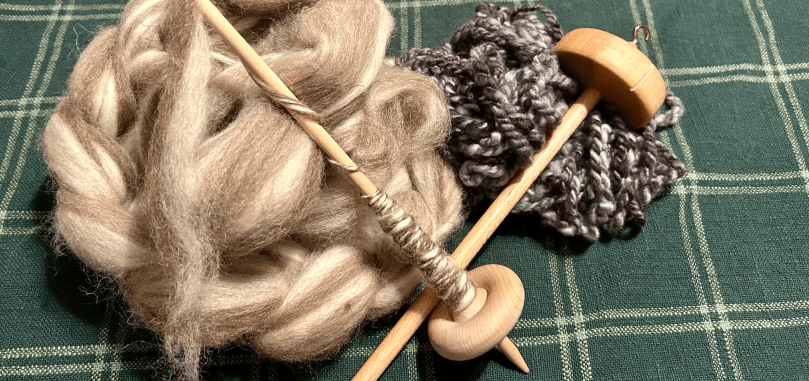
A top-whorl drop spindle and a bottom-whorl drop spindle crossed and resting against brown and cream wool roving and blue-gray hand-spun yarn.

Who Was Going to Tell Me About Distaff Day?

My first post for Forþ-weard was about about tailoring your personal sacred calendar to your own praxis. Well, I have a new example for you happening in my own praxis in real time.

I recently—as in, during the last 48 hours—learned of the concept of Distaff Day (this is the part where you can all point and laugh at the silly American). Anyway, as someone whose praxis is largely dominated by Frīg, I am enamoured of this concept. Now, as far as I’m aware, this holiday is wholly Christian in origin1, being the day following the feast of the Epiphany, but it’s also been taken up secularly by people in fiber arts communities (which is how I came to learn of it)2.

In continuing on with that first post about fleshing out your own holiday calendar, I’m thinking I want to find some ways to incorporate Distaff Day into my rotation. Here are the traditions I’m considering starting for myself:

  • I didn’t spin at all during Geol this year more out of coincidence than conscious choice, but I’m thinking having an intentional fiber arts hiatus from Mother’s Night through Distaff Day in the future. There’s precedence for this practice, too.3
  • Scheduling a vacation day from work if January 7th happens to fall during the week and I have the time available.
  • Designating Distaff Day as when I will begin my first project of the new year.
  • Making an offering of my first spun yarn of the new year to ask Frīg’s blessing on my new endeavors.
  • Joining a local yarn spinning event, class or workshop that day if one is available.
  • Treating myself to a new distaff or spindle if needed4

These may seem like small things, but recently I’ve decided that I want to get more serious about devotional craft work—and just generally becoming better at spinning. I love the idea of formalizing and ritualizing the beginning of my crafting year just a little bit to help me in these goals.

So, who wants to join me in celebrating a heathen-ified version of Distaff Day? Let me know if you have any other ideas on how we could celebrate!

  1. If I’m wrong about this, please feel free to point me to some sources in the comments. I’d love to see them! ↩︎
  2. Specifically, I saw this video on YouTube by JillianEve. ↩︎
  3. Jacob Grimm states in Teutonic Mythology V.1 that “In the North too, from Yule-day to New-year’s day, neither wheel nor windlass must go round.” ↩︎
  4. I don’t actually own a distaff of any kind at the moment, and it’s something of a hinderance to my progress with my drop spindles. ↩︎
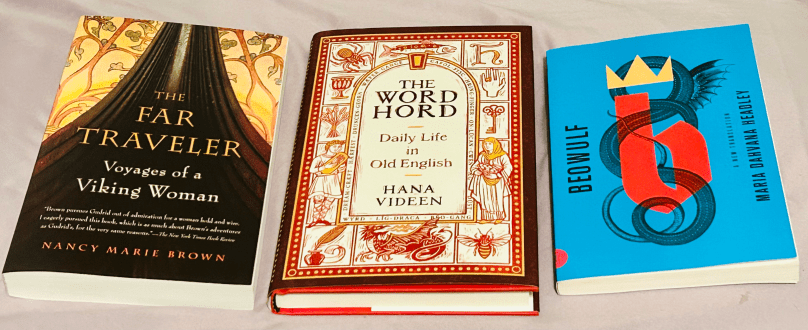
3 books in a row from left to right: The Far Traveler by Nancy Marie Brown, The Word Hord by Hana Videen, Beowulf translated by Maria Dahvana Headley

My Favorite “Heathen-ish” Reads of 2023

I’m starting this off with a disclaimer that none of these books are explicitly “heathen.” They aren’t written for a heathen or pagan audience, nor are they about the religion itself. But they are adjacent, covering areas of history and literature that are interesting to people with heathen leanings. I should also note most of these books are not new, I just happened to read them this year. With that out of the way, here’s some of the best books I read in 2023:

Beowulf, A New Translation by Maria Dahvana Headley

This was barely a 2023 read for me, considering I received it as a holiday gift, but it was a quick read. I have never laughed so hard while reading a Beowulf translation. I’m totally here for the vibes. Perhaps not the most accurate translation of Beowulf on the market (I wouldn’t use it for reconstruction purposes, for sure) but definitely one of the most entertaining. 5/5

The Far Traveler: Voyages of a Viking Woman by Nancy Marie Brown

This book is a mix of travel diary and popular archeology that is certainly interesting. It could be a little slow in places, and it wasn’t as much biography as I was expecting based on the synopsis. Still, it was an enjoyable and interesting read. 3.75/5

Winters in the World by Eleanor Parker

Full disclosure, I haven’t actually finished this one quite yet, but I am enjoying it. The book is of course dealing with Christian Anglo-Saxon England, but there’s still little nuggets there for the interested Fyrnsidere to uncover. As someone who is trying to get back in touch with natural cycles and rhythms, this was an interesting book to dive into.

My 2024 TBR

I also received The Word Hord: Daily Life in Old English by Hana Videen as a holiday gift this year. I haven’t gotten a chance to dive into it just yet, but I am absolutely stoked to do so. Let me know if y’all would like a review of it when I’m finished.

Another book I’m hoping to get to in 2024 is The Darkening Age by Catherine Nixey (I read part of it, but then my library loan expired. Whoops).

I’m always on the hunt for more books to add to my TBR (to be read) pile, so if you have any suggestions, please let me know!